
The epic poem attributed to Homer (though was more likely a word-of-mouth story that passed through many storytellers over many, many years), The Odyssey is one of those stories that everyone knows at least a little something about it, having been around for thousands of years. It has been retold and retranslated numerous times, as well as reinterpreted depending on the interpreter’s thoughts and understanding of the text. The same goes when a written story is translated to screen. Some things will remain the same, but there will also be a ton of changes that ought to serve the visual format. This has been done countless times with book adaptations, and Christopher Nolan’s version of The Odyssey is no different. But does it relay the essence of the text while being a Nolan-standard visual treat, or does the need to be visually entertaining detract from the bones of Homer’s epic poem?


Director: Christopher Nolan
Writer: Christopher Nolan, based on Homer’s Odyssey
Cast: Matt Damon, Anne Hathaway, Tom Holland, Robert Pattinson, John Leguizamo, Jon Bernthal, Himesh Patel, Lupita Nyong’o, Zendaya, Charlize Theron, Samantha Morton, Benny Safdie, Elliot Page
After his plan to build a horse and hide a bunch of Greeks in it ensured they won the ten-year Trojan war, Odysseus (Damon), king of Ithaca, wishes for nothing more than to get home, back to his loyal wife Penelope (Hathaway) and son Telemachus (Holland), as do his men. However, the gods have other plans for Odysseus. Charting the next near-ten more years of his life (in a non-linear fashion), he and his men come up against many a mythical being in their quest to return to Ithaca, each hindering their journey. All the while, Penelope and Telemachus attempt to fend off numerous suitors who demand Penelope remarry to one o them, with Penelope insisting that Odysseus is still alive and Telemachus on a mission to find out what exactly happened to his father after the war.
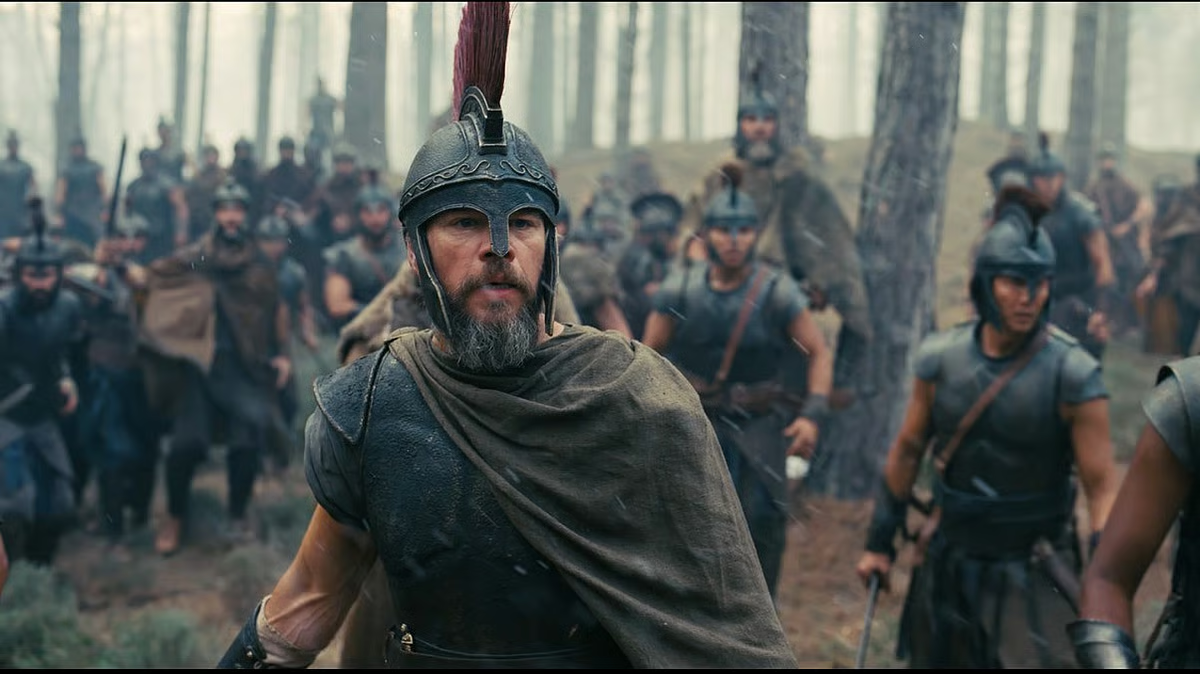
To go into a Nolan film is to know that you are about to see something visually stunning. Put aside the IMAX camera, 70mm film and incredible eye of cinematographer Hoyte van Hoytema, and beyond that you have something that really stands on its own two feet. Every set design, every costume, every prop, every animatronic, puppet and prosthetic is a testament to Nolan’s wish to use little to no CGI in order to create something that feels authentic and will entertain and astound. The sound design and scoring by Ludwig Göransson sings in tandem with the cinematography, though I have to wonder if it all had to be quite that loud? In spite of historical inaccuracies, the feeling of The Odyssey being an ancient myth, and Odysseus himself being a mythical figure, is thoroughly palpable. It doesn’t have quite the same legendary vibe to it as 2004’s Troy had, but it is more grounded in its story and characters and less OTT than Troy.
Nolan’s Odyssey, while influenced by a few translations of the text, steers quite a way away from the poetry of the piece. It cannot be denied that, much like other Nolan productions, The Odyssey is a masterclass in the visuals of epic filmmaking, however it appears that style was favoured over true substance. The film is well worth the near-three-hour mark, and admittedly it would have had to have been condensed for timing, but it misses some context and story surrounding some of the people, especially the women (such as Circe and Calypso), and creatures (particularly Polyphemus the Cyclops) that Odysseus encounters, as well as the way in which he reveals himself to Eumaeus and Telemachus and leaving out any corporeal representation of gods that have a large part to play in keeping Odysseus from Ithaca, like Zeus and Poseidon. It’s a sad loss of depth that could have really taken the film to the next level. Having said that, credit where credit’s due in that Nolan took the time to allow Odysseus to reflect on the war and the catastrophic change it made to the way the Greeks lived their lives and how his journey could have been some kind of retribution for being the catalyst for this change.
The use of modern language and accents has also been a source of controversy, but in the same way that I am a champion of Emily Wilson’s translation making the poem more accessible to modern readers, I think Nolan’s choices for the dialogue also make the film more widely accessible (and therefore able to make a profit on its $250 million budget). It does feel kind of jarring every so often, to see something based in antiquity yet with characters using modern language and a large amount of historical inaccuracies, but it’s something that we ought to forgive for the sake of it being, a) a mythical story anyway, and b) a Hollywood movie, the kind of place where the local DMV also hands out Poetic Licenses like they’re going out of style.
I don’t think Matt Damon would ever have been on my list of potential actors for Odysseus (how I wish this was made twenty years ago and Sean Bean could have returned in the role!), however I think he did a great job of it. The character was perhaps a little flatter than I’d have expected, but Damon very much owned the screen without having to do a whole lot some of the time. Anne Hathaway is also a pleasant surprise as Penelope, getting her teeth into a terrific character, even if Penelope is a little two-dimensional in this film. Tom Holland is a great Telemachus, a good balance of youth and strength, and Robert Pattinson puts his villain eyes to good use as Antinous, one of Penelope’s main suitors. I think the film was well-cast on the whole, though some could have benefited from a little more development in their characters.
The Odyssey will probably be up for a few awards in a few months, but it is no Oppenheimer. Nolan did what he does best in this film, and that’s putting a story to screen and making it a consistent piece of entertainment, but it’s unusual that he forwent strength of story and chose to focus more on the visuals. Scholars of the poem might be disappointed that the film isn’t as classical as old Hollywood might have made it, but as modern filmmaking goes, I guess it made sense for a film of this scale to be dialled back a little, even if it loses that one thing that could have really helped set its mark in the pantheon of cinema.


Leave a Reply