
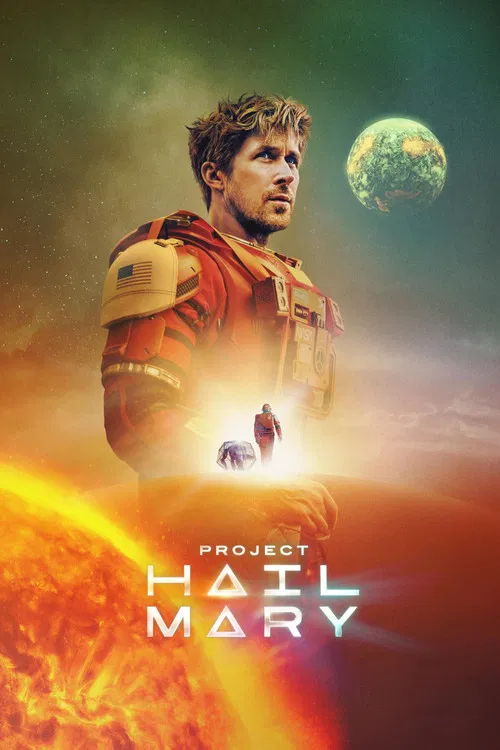

Directors: Phil Lord, Christopher Miller
Writer: Drew Goddard, based on the novel by Andy Weir
Cast: Ryan Gosling, Sandra Hüller, James Ortiz, Lionel Boyce
When we think of sci-fi, specifically space-set sci-fi, we’d be forgiven for thinking it will be full of hi-tech and cosmological jargon that could be hard to follow and characters that are in dire situations that usually involve a planet or two that are close to extinction. While Project Hail Mary is very much a space-set sci-fi and does involve a heck of a lot of real, hypothetical and fictitious jargon and dire situations, it has something that we don’t always see in a film of this genre: humour and a reluctant hero. Perhaps if you’ve seen The Martian, which was also adapted by Drew Goddard and based on another Andy Weir novel, you’ll recognise the kind of tone Project Hail Mary has. Does this mix of comedy and sci-fi work for a film that is so science-heavy and make it entertaining, or does it come across as mis-matched and difficult to believe in?
In a far-off star system, molecular biologist Ryland Grace (Gosling) awakes to find himself alone and suffering with amnesia aboard the starship Hail Mary. He soon remembers he is there to find out why the star-system’s sun Tau Ceti is not being affected by Astrophage, a microorganism that eats up stars, including Earth’s own Sun. In order to save Earth, and potentially other planets, Grace works to find a way to stop the Astrophage while recovering his memories of what happened before he left Earth. But soon after he arrives at Tau Ceti, Grace comes to find that he is not the only one from a nearby star-system that has arrived to find a way to save his planet.
The main thing I noticed about this film is how tonally faithful it is to the book. Goddard deftly captured Grace’s humour, both light and dark, and directors Phil Lord and Christopher Miller were faithful to turning an apocalyptic event into something that has a thick, clear vein of hope running straight through it. In fact, it probably runs more like an essential artery, with editor Joel Negron and composer Daniel Pemberton working alongside Lord and Miller to keep things relatively upbeat. It’s a reflection of Grace’s own inner workings: in spite of his circumstances, he tries to use humour as a defence mechanism lest he succumb to the desperation of the situation, his isolation and his own reluctance at being Earth’s hero. His choices aren’t the kind of choices anyone would like to make, whether the survival of humanity and the Earth depended on them or not. The editing boosts the humour of particular situations and the music encourages optimism and a light-hearted atmosphere. The sciencey jargon is a little heavy and maybe a little easier for those who have read the book to follow, particularly as so much of it is condensed into a little over two hours and the ending also being hugely shortened, with some details I’d consider important from the book being glossed over, but such is the nature of filmmaking, I suppose. Overall, Goddard provided enough in his screenplay for a basic(!) understanding of the science, as long as you can keep up, and kept the story as succinct as he could.
Although the 2026 Academy Awards have just passed, it would be a huge misstep on the Academy’s part if Project Hail Mary wasn’t nominated next year for its sound and production design. The moments of pure silence followed by non-frightening alien-sounding tones alongside upbeat compositions genuinely give a feeling of being in space but in a less scary way. The designs of both the Hail Mary and the ship belonging to the alien (trying to avoid spoilers here!) bring Weir’s descriptions wonderfully to life, and the design of the alien itself, while a little smaller than I personally imagined, was very well-done, particularly as it was probably difficult to figure out how to help it evoke emotion when lacking certain features.
There has perhaps rarely been as perfect a casting as Ryan Gosling for the role of Ryland Grace (even their names are somewhat similar). His talent for comedy comes in handy as he embodies the comedic stylings and sarcastic wit of Grace while also adeptly conveying his turmoil that he attempts to hide. It cannot have been easy to act alone or with a prop for half of the film, or pretending to be in space, but after projects such as First Man and Blade Runner 2049, he’s probably an expert in acting with green screens and props these days, and it shows. Sandra Hüller was also excellent casting for the generally blunt and apparently unfeeling Eva Stratt, the head of Project Hail Mary. Stratt is a complicated yet understandable character, the one that has to make the hard decisions but who will not apologise for them, and Hüller is able to portray her both sympathetically and antagonistically.
Personally I very much enjoyed Project Hail Mary the book quite a bit, though I did find Grace to be rather grating at times with his brand of humour, but I enjoyed the film slightly more, possibly thanks to Gosling’s less discordant performance of Grace. I think if they had known the hit this film would be, perhaps the studio would have allowed for a slightly longer run time with a little more detail, especially toward the end, but as it stands with the time constraints, the cast and crew did an astounding job. They were faithful to the book (it probably helped that Weir was on the production team) and made exactly the right calls with Goddard and Gosling. A very entertaining, blockbuster sci-fi that will leave you laughing, crying and gripping your seat with anxiety and anticipation.



 Dawn of the Tapes
Leave a comment