
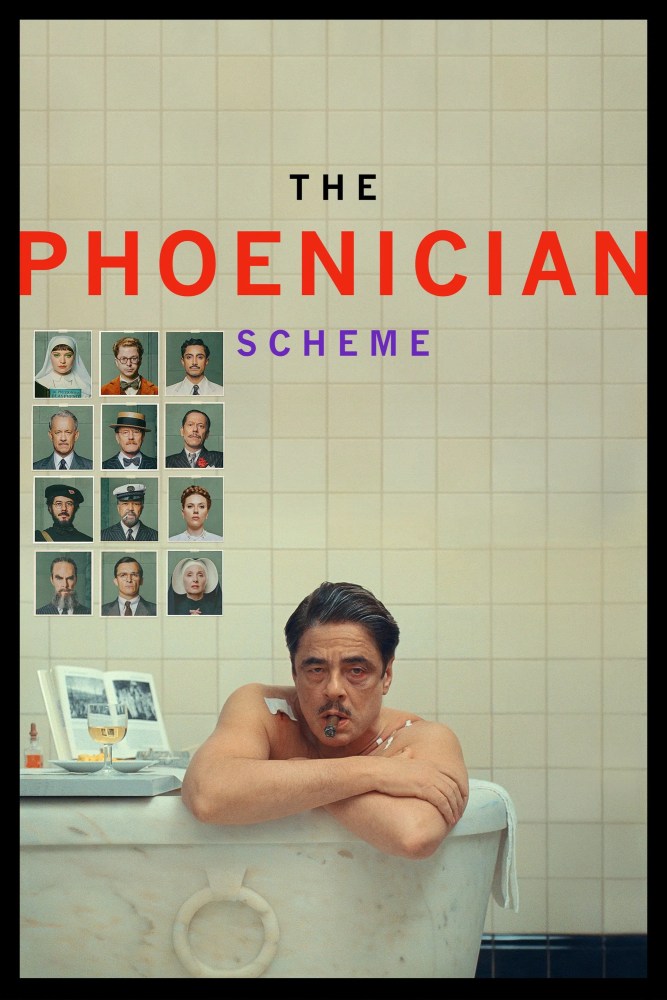

Director: Wes Anderson
Writers: Wes Anderson, Roman Coppola
Cast: Benicio del Toro, Mia Threapleton, Michael Cera, Riz Ahmed, Tom Hanks, Bryan Cranston, Mathieu Amalric, Richard Ayoade, Jeffrey Wright, Scarlett Johansson, Benedict Cumberbatch, Rupert Friend, Hope Davis
Just two years after his last project, writer/director Wes Anderson returns with his latest quirky film (and hot on the heels of a TikTok trend that sees creators making videos based on Anderson’s signature style). It’s not too bold to say that Anderson’s films are often like marmite: you either like them, or you don’t. Some are better (The Darjeeling Limited) than others (The Life Aquatic), depending on your taste, but on the whole, Anderson knows what he’s doing, particularly when it comes to knowing who to collaborate with on his projects. Does The Phoenician Scheme land squarely on the Anderson Scale of Good to Great™, or is he going to finally drop below a three-star film?
Following many assassination attempts on his life, arms dealer Anatole “Zsa-Zsa” Korda (del Toro) tracks down his estranged only daughter Liesl (Threapleton), who has become a nun, to make her his heir, in spite of having nine sons younger than Liesl. As a big consortium fixes the price of bashable rivets, an arrangement that will collapse Korda’s scheme in Phoenicia and affect the funding deficit of his work, he takes Lisel and his new assistant Bjørn (Cera) to Phoenicia to meet with multiple benefactors and convince them to cover some of the deficit, all while the assassination attempts continue.
This film has probably the most unclear and confusing plots of Anderson’s projects, but it’s not really all that important to fully understand what is going on, because, as with the majority of his films, most of it is about the visuals and the character relationships, the former bearing all the hallmarks of an Anderson picture and the latter a standard practice of Anderson’s frequent collaborations with co-writer Roman Coppola. As eccentric as the story is, the characters are what make it work and keep it rolling along, and for the majority of Phoenician, they do just that, something that becomes more and more necessary as the story gets a little repetitive in its structure. Korda is a solid main character who is interesting to follow and certainly has all the dry humour and blunt dialogue we’d expect, and Liesl is the perfect sceptical antidote to her father’s grand intentions. You can also expect to see some familiar faces of Anderson’s work popping up here and there alongside actors with whom he has not yet worked (each film feels like Anderson has a bingo card somewhere that he adds stamps to every couple of years).
If you’re familiar with Anderson’s films, you’ll understand why there’s no need to delve into the visuals as it’s pretty much what you’d expect, but for the uninitiated, expect a lot of angular and off-centre shots as the cast often follow the camera rather than vice-versa, superb framing that really scratches an aesthetic itch, and block colours or patterns that set the tone of each scene. All of this works collectively to create meaning for everything you see and heard that could easily fall apart were one aspect to be taken away, in a similar way an assortment of instruments works together to build a piece of music that would sound incredibly different with just one instrument removed. At times it may prove distracting to be focused on the unusual filming style to a newer audience, but for the most part it works with the flow of action and dialogue and general mise en scène.
Anderson never appears to be short of actors who wish to work with him/appear in his films, and it’s a marvel that he’s able to choose just the right actor for each part. Benicio del Toro is quite a versatile actor and isn’t new to the Andersonverse, so he easily falls into the part of Korda and his stubborn ways, and although his actions are a little predictable at times, del Toro keeps us engaged in Korda’s development. Threapleton is a great straight-laced nun and does a superb job of slowly getting Liesl to loosen up and come around to her father’s way of doing things. Cera, often known for his quirkier roles, manages to swing between quirky and less so in a way that shows his own growth as an actor, making Bjørn far more interesting than he probably ought to be. With a terrific ensemble overall it would take a while to go through each actor’s performance (and the majority not having all that much screentime anyway), but rest assured, each one makes his or her mark on the film, even if it feels a bit too ‘look-who-it-is-now’ sometimes.
It can be difficult to review Anderson’s films as they mostly follow the same formula. The trick is to find where they differ, and that usually comes down to the overarching story itself. For The Phoenician Scheme, the story isn’t Anderson’s (and Coppola’s) most interesting or easy to follow, but it does keep up the absurdity of the settings and motivations of the characters, who are easier to follow and understand, as is standard of one of his films. Is this one of his better ones? Well, it comes in at the slightly lower end of the Anderson Scale of Good to Great™, but still ranks slightly above average. It’s a worthy addition to the filmography, but it would be good to see a better balance of story and character (à la The Grand Budapest Hotel or Moonrise Kingdom) again.
Watch out for Dawn of the Tapes’s Film Club – Wes Anderson coming later this week!


 Dawn of the Tapes
Leave a reply to Film Club – Wes Anderson – Dawn of the Tapes Cancel reply