
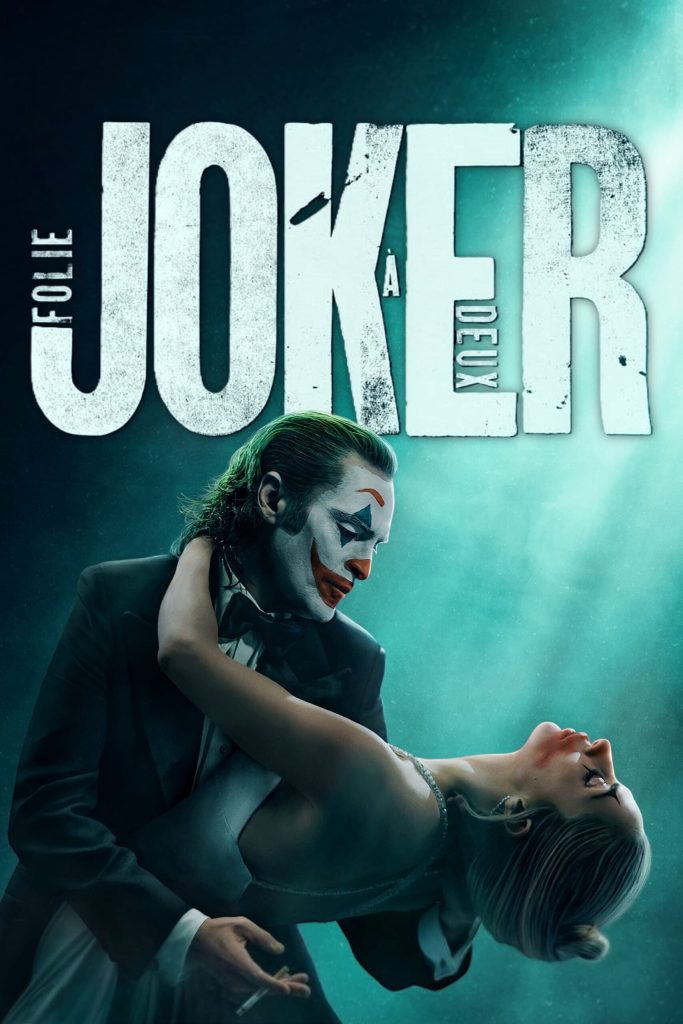

Director: Todd Phillips
Writers: Todd Phillips, Scott Silver
Cast: Joaquin Phoenix, Lady Gaga, Brendan Gleeson, Catherine Keener, Zazie Beetz, Steve Coogan, Harry Lawtey, Leigh Gill
In 2019, we were gifted – yes, gifted – with Joker, a remarkable film that had a lot to say and a lot to show. Now, Phillips returns with a sequel, a sequel that’s sure to court controversy as much as its predecessor. The character of the Joker is renowned for being Batman’s arch nemesis, but Phillips was able to strip the character of his stereotypes, dress him up in a fresh costume that shone a new light on the character and move him away from the constraints of the comic books and into a universe of his own with not even a mention of ‘Batman’. Has Phillips managed to recreate his lightning in a bottle in a non-repetitive way, or are we just being shown the same themes through the same medium but with more clown make-up?
***Please take note, there will be spoilers for 2019’s Joker in this review.***
In the aftermath of the events of Joker, particularly the murder of talk show host Murray Franklin (Robert De Niro) live on air, Arthur Fleck (Phoenix) is arrested and thrown in a prison with highly controlling and abusive prison guards. Picking up two years later, Arthur has grown a huge following, or rather his alter-ego, Joker, has. He is awaiting trial, his lawyer wanting to argue that Arthur suffers from dissociative identity disorder and not he, but rather Joker, should be held responsible for his crimes. Due to good behaviour, Arthur is allowed to attend a music therapy class, where he meets Harley “Lee” Quinzel (Lady Gaga). As the two become more enamoured with each other, Arthur’s confidence in Joker grows, and his wish to be noticed for his comedy and just loved comes more and more to the fore.
The downside of a sequel to Joker is that the message is not easy to replicate; the themes surrounding corruption and abuse at all levels, mental illness and the lack of services and funding for mental health and the potential repercussions on a larger scale were heard loud and clear, and thus repeating them would make a sequel feel pretty stagnant. While Folie à Deux does indeed repeat its themes and make it ever more apparent that Joker was meant to be a standalone film, it does manage to take them even further by using multiple genres to represent Arthur’s deranged psyche. It does work to keep the audience interested and invested, but, unlike Joker, the pacing of Folie à Deux is unbalanced at times, dragging a little in the first half then speeding up too much toward the end, making it feel a little monotonous now and then.
The biggest thing they did right in this film is not fully linking Arthur/Joker to Batman – there are minimal connections to that world, but nothing that screams ‘Batman’ – these films are about Arthur Fleck, and they resolutely remain so. Even with the inclusion of Harley Quinzel, it was easy to forget the larger world the character is usually a part of. As a result, there is a lot more realism to Folie à Deux, and even the city of Gotham could easily be a New York or London or Paris or any real major city. In spite of the film’s opening (a short animated sequence recapping the end of Joker in a mildly amusing way) and Arthur’s fantasies that are woven throughout, it’s very much grounded in reality and much of it is very sobering, particularly the complexities of despising Arthur’s actions yet understanding them in a way and even feeling empathy for him by the end. The film is a courtroom drama, a musical, a romance, a comedy, a tragedy, and much more besides. It will feel jarring to some, but it works perfectly well for the character, with his split personality and need to feel happier in his fantasy world. It also makes it all the more devastating when we witness all the abuse Arthur continues to suffer and the way he is used and/or idolised for all the wrong reasons.
As mentioned, the crossing of genres can be a little overwhelming, but it keeps things interesting, particularly where the sets and costumes are concerned. The real world has the usual settings of any crime drama: prison, courtroom, police cars, drab and depressing and back again. But Joker’s fantasy world is generally bright with colourful make up and costumes, soundtracked with upbeat music and singing. It breaks the monotony and depression of Arthur’s real life, that is, until reality begins to seep in. The musical numbers in particular are very well done, particularly with appropriately less-than-perfect vocals and songs that sync well within the mise-en-scène. It’s all very meta in execution, too – the film is aware of what it’s doing and what its audience is probably thinking. Somehow, that feels like a very ‘Joker’ thing to do.
Phoenix masterfully and effortlessly slips back into Arthur’s shoes, as though he’d never been away. His performance in Joker was outstanding, winning him an Academy Award, among other accolades, and he does not disappoint once again in Folie à Deux. He goes even further into Arthur’s disturbed mind and pushes his performance in song and dance, too. Likewise, Lady Gaga gives an understated but strong performance as Lee. Her musical talents aren’t utilised to the degree we’re used to, but that works perfectly well for the character, and she underscores Phoenix’s performance wonderfully, the pair working in tandem for excellent chemistry on-screen. Gleeson is a terrifying presence as a deplorable prison guard that tempts the audience to understand Arthur’s experiences in a more empathetic way, and Keener’s do-gooder attorney feels like the only sane performance of the entire film, perhaps reflecting some audience members who feel that empathy for Arthur.
As predicted, this film is definitely polarising, but the fact that is intended to make some sort of commentary on its initial “haters” hasn’t gone amiss. For those that enjoy the Joker movies for what they are will get a lot out of them, but those who are purposely looking for a lack of virtue or just something to pick on will probably still get something out of it for their own ends. Phillips and his cast and crew might have set out to partially make something to piss off their critics (both professional and non), but there’s so much more to take from it than a middle finger. Folie à Deux doesn’t quite reach the same heights as Joker, but it is still a strong film with enough to think about and certainly more than enough entertainment.



 Dawn of the Tapes
Leave a comment