

Director: Kelsey Mann
Writers: Kelsey Mann, Meg LeFauve, Dave Holstein
Cast: Amy Poehler, Maya Hawke, Kensington Tallman, Liza Lapira, Tommy Hale, Lewis Black, Phyllis Smith, Ayo Edebiri, Adèle Exarchopoulos, Paul Walter Hauser, Yvette Nicole Brown, Lilimar, Grace Lu, Sumayyah Nuriddin-Green, Kyle MacLachlan, Diane Lane
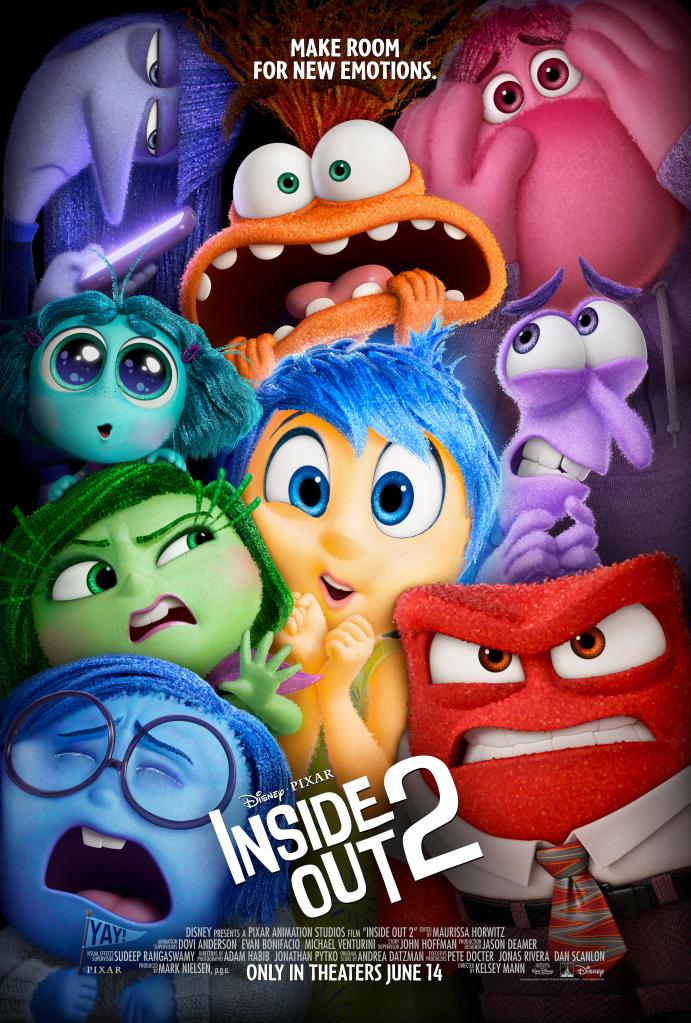
Nine years ago, we were given a rather delightful film from Pixar and Disney called Inside Out. The premise is that a young girl, Riley, tries to adapt to her new home after her family moves, and we see it all through five of her anthropomorphised emotions – Joy, Anger, Fear, Sadness and Disgust. It was highly commended for its portrayal of the emotions, its messaging and its themes. Now, we have a long-awaited sequel that promises the return of the five emotions alongside four new ones. Have Pixar and Disney kept to the idea of exploring emotions candidly, or is this yet another sequel for sequel’s (and money’s) sake?
Riley (Tallman) has just hit her teens and is about to enter high school. Before doing so, she attends an ice hockey camp for a weekend with her two best friends. Meanwhile, her emotions – Joy (Poehler), Anger (Black), Fear (Hale), Sadness (Smith) and Disgust (Lapira) – have introduced a new part of Riley’s mind: her Sense of Self. As they prepare for Riley’s incoming puberty, signified by her overreaction to each emotion, four new emotions move in to her mind: Anxiety (Hawke), Envy (Edebiri) Ennui (Exarchopoulos) and Embarrassment (Hauser). This begins to disrupt the status quo of Riley’s personality and affects her Sense of Self, and as they cause mayhem in Riley’s mind. As Riley’s beliefs begin to shift, Anxiety banishes the five original emotions to the back of Riley’s mind, and Joy must find a way to get them all back and save Riley from herself.
The premise of the first Inside Out movie was a very clever idea, to personify emotions and deal with certain themes within a kids’ movie. The premise to Inside Out 2, where Riley is about to become a teenager, arguably the most tumultuous and emotionally charged time of a human being’s life, is really a stroke of genius (there is so much going with a teenager’s changing body and mind that they could make an entire long-running TV show out of it). The writers have handled the subject matter rather well; most of us remember what it was like becoming/being a teenager, our personalities changing and morphing into something/someone new while pushing boundaries and making mistakes, sometimes consciously, other times unconsciously. The newer emotions introduced come under the umbrella of Riley becoming insecure and overly self-aware, and these are portrayed well through Riley outwardly and the way her emotions are at war with each other inwardly. Not to mention, the way Joy comes to realise that it is very difficult to keep up appearances of happiness when reality is starting to hit Riley is certainly one of the core takeaways of the film.
In the previous movie, we were shown all kinds of corners of Riley’s mind. Now, we see how these areas have changed, some for the better, some for the worse – either way, all fairly natural in the case of growing up. We are also introduced to new places, such as the Memory Vaults where Riley keeps her secrets, both typical (crushes) and atypical (a Big Dark Secret that is revealed if you stay beyond the end credits), and the pool of beliefs from which Riley’s Sense of Self grows. All are very imaginative creations that make something tangible out of what we only know to be intangible within our brains. In particular, the introduction of Ennui as an emotion is so, so real, especially in this overwhelming day and age where we can be overwhelmed to the point of inaction.
Performance-wise, all voice actors do a great job, but Hawke particularly as the newly introduced Anxiety is a standout. Considering this emotion is quite a turning point in a teen’s life, Hawke gives a good performance that encompasses a lot of uneasy tones familiar to anxious feelings. It was a shame not to have Bill Hader and Mindy Kaling back as Fear and Disgust, respectively (apparently due to a pay dispute), but Hale and Lapira do a perfectly fine job in the roles. Tallman expresses Riley’s outward emotions very well, and keeps up with the constant changes in Riley very well (it certainly helps that Tallman is still a teenager herself).
Overall, the film has a very positive yet realistic message, in that we are not simply boxed into a handful of emotions; people, especially teens, are much more complex than that, and it could prove to be a very important film for children and tweens in the future in helping them to understand how and why they’re changing and that it’s ok to make mistakes as they figure things out for themselves. Perhaps the only slightly unrealistic aspect is Riley’s relationship with her parents – it’s hard to believe any teen has that good of a relationship with their parents, but I’ll let it off under the guise that it’s just trying to set a good example of being aware of your emotions and when they’re being unreasonable to the point of necessitating an apology (much like how Riley is with her friends). Pixar and Disney have very much hit the mark with Inside Out 2, and I will look forward to another instalment (Riley falling in love? Becoming an adult? Who knows).


 Dawn of the Tapes
Leave a reply to Elio – Dawn of the Tapes Cancel reply