
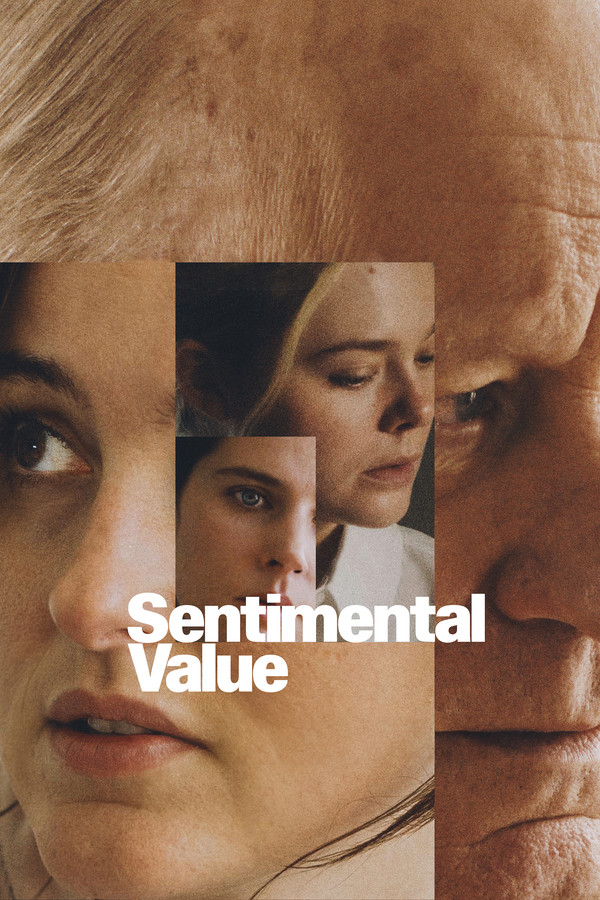

Director: Joachim Trier
Writers: Eskil Vogt, Joachim Trier
Cast: Stellan Skarsgård, Renate Reinsve, Inga Ibsdotter Lilleaas, Elle Fanning
Family dynamics both good and bad have always been and will always remain an interesting subject in creative spaces. Exploring family-centric issues can be therapeutic for both the creators and their audiences, but it’s not always an easy pill to swallow, especially if one happens to grow up in a less than “ideal” family. In the context of Sentimental Value, the relationship between a father and his daughter(s), in this case a father who constantly allows his creative whims to whisk him away from his family, is a delicate one. It is arguably the most protective of familial relationships, and yet the most contentious. Does Joachim Trier’s latest film explore this connection truthfully, or are we left with another film that prefers to wade in the shallow end of the gene pool?
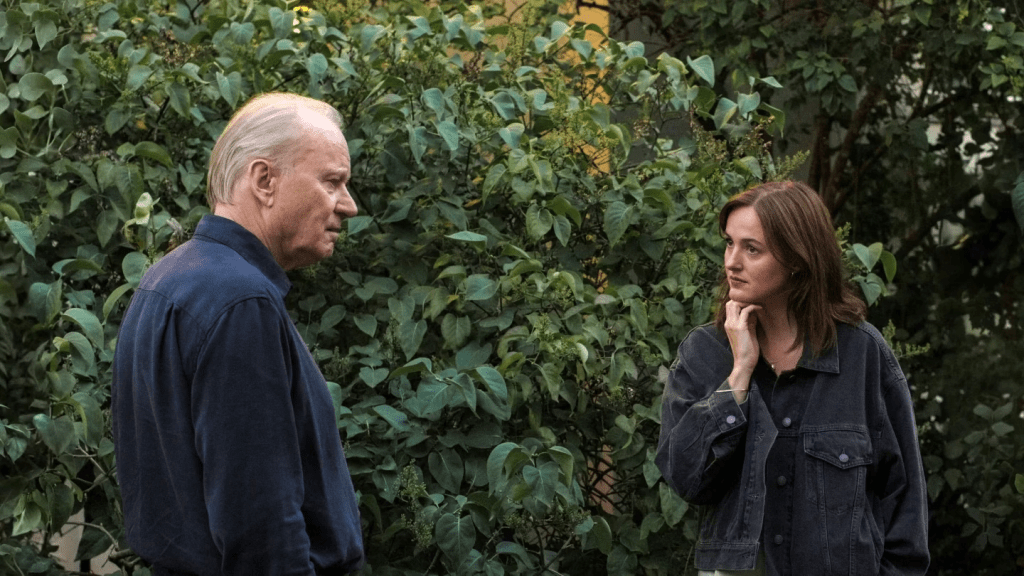
After the death of his ex-wife, filmmaker Gustav (Skarsgård) returns to Oslo to reclaim his ancestral home that his own mother committed suicide in and that his estranged now-adult daughters Nora (Reinsve), a stage actress, and Agnes (Lilleaas), a historian, grew up in. Gustav attempts to reconcile with Nora and Agnes, letting the women know that he has written a new film that he wants Nora and Agnes’s young son to star in, and while they both harbour a certain amount of resentment towards him, Agnes is more sympathetic than her older sister. Throughout the attempts at reconciliation, flashbacks to Nora and Agnes’s childhood in the house and the fractious relationship between their parents add stock to their current feelings towards Gustav, as well as his decision to make the film in English and hire American actress Rachel (Fanning) to play the role intended for Nora.
One of the biggest themes to note about Sentimental Value is that of generational trauma, a psychological trauma that has only more recently gained traction in the medical world in understanding and determining how and why certain traits or mental health issues are passed down within families. It can make sympathetic characters out of any person who has had this trauma passed on to them and who continues the cycle through their own actions, and can make empathetic characters of us. This is, in part, what happens with Gustav. While it is easy to criticise him for leaving his family when things get tough – divorce is one thing; skipping the country entirely is another – his backstory with his mother, a survivor of Nazi torture, provides a level of exposition that has been mostly unexplored in film up until recently, that of the generational trauma. Does it excuse how he abandons his daughters frequently? Not at all, however it does provide a reason, which is quite different to an excuse.
Trier, along with co-writer Eskil Vogt, do an amazing job of using the trauma as a jumping off point to explore not only Gustav’s personality but how it affects his daughters and their own relationships, both of whom have very different lives: Agnes appears happily married with a young son, but Nora is single, though in the midst of an affair with a married man, and suffers deeply from stage fright. It seems Agnes was able to not allow her family’s past to affect her own want of a family, most likely because Nora protected her as well as she could, but Nora, being the eldest and without emotional protection, appears to struggle more. It’s truly a fascinating insight and one that I can, sadly, very much relate to.
The settings are often as striking as the story and performances. Gustav’s family’s home in particular says so much with the use of colour, and the later lack of, and the props speak to the chaos or calm depending on who is within the house and the time in which it is set. Even the homes or temporary habitations of Gustav, Agnes and Nora act as representations of them: Agnes with her full home, Nora with her near-empty apartment, and Gustav having people almost constantly in and out yet usually ending up alone. The beautiful use of Oslo as a backdrop to the family drama also cannot go unnoticed; most of the action takes place inside, but the little we get to see outside literally and figuratively allows a breath of fresh air and a break from the confining homes, for both the characters and the audience.
The performances are, across the board, fantastic, with Stellan Skarsgård, Renate Reinsve, Inga Ibsdotter Lilleaas and Elle Fanning all up for the big acting awards (namely Best Actress for Reinsve, Best Supporting Actress for both Lilleaas and Fanning and Best Actor for Skarsgård at the Academy Awards). Skarsgård is, as always, very genuine in his portrayal of Gustav, and in spite of the stroke he suffered in 2022, he remains as prolific as ever. Not to get too personal, but having been divorced once himself, being a father of eight (with just one daughter amongst them!) and a very successful and in-demand actor, I would be surprised if he didn’t relate to Gustav in a lot of ways. Both Lilleaas and Fanning are wonderful, though Lilleaas’s character allows for more depth and a wider range, of which Lilleaas excels at making the most of. Reinsve, however, outdoes them all. I have only seen a handful of her performances, but she blows me out of the water every time, no matter the genre, the character, the language; whatever she does, she is effervescent and makes acting appear effortless. Although Nora is a terrifically written character, Reinsve makes her fully three-dimensional and one of the most relatable characters I have seen in a long time.
I’d love to know exactly where the inspiration for this film came about for Trier and Vogt, because it has an authenticity that most films of this genre struggle to depict. Perhaps it’s the fateful amalgamation of excellent writing, production and performances that makes this film a real moment in cinema. It speaks to the past, the present and the future, making it possibly timeless in the pantheon of films. It’s little wonder Sentimental Value has been nominated for numerous awards, including Best Film/Picture, Best Director/Direction and Best Original Screenplay at the Academy Awards and BAFTAs. It is very well-deserved, all of it.


 Dawn of the Tapes
Leave a comment