
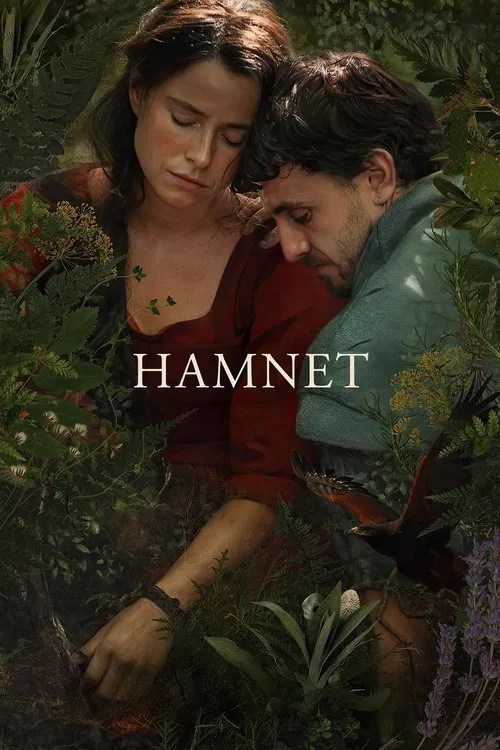

Director: Chloé Zhao
Writers: Chloé Zhao, Maggie O’Farrell, based on the novel by Maggie O’Farrell
Cast: Jessie Buckley, Paul Mescal, Emily Watson, Joe Alwyn, Jacobi Jupe, Olivia Lynes, Noah Jupe
The world is very familiar with William Shakespeare and Hamlet, his tragic play about a Danish prince avenging his father’s death. But perhaps less well-known is the possible inspiration behind the play, that of the also tragic death of Shakespeare’s own young son, Hamnet. In her novel, Maggie O’Farrell creates a fictional story (with a basis in known facts about Shakespeare and his family) in which Shakespeare meets his wife Agnes (more commonly known as Anne), a woman many consider to be a witch and who is socially outcast, and they build a family while Shakespeare builds his career as a playwright. It also explores how Hamnet’s death may have affected both Shakespeare, particularly in his writing, and Agnes. This long-awaited screen adaptation has the benefit of being co-written by O’Farrell, but has it translated well onto screen, or is this yet another example of a book being adapted poorly with too many missing elements?
In the late 1500s, William Shakespeare (Mescal) works as a Latin tutor for a family his father is indebted to. It is here he meets the family’s eldest daughter, Agnes (Buckley). Agnes soon finds herself pregnant and, to the reluctance of both families, marries William. After some time, Agnes finds herself pregnant again, this time with twins Hamnet (Jacobi Jupe) and Judith (Lynes). She raises her children in a similar vein in which she was raised by her mother, learning from and understanding nature and remaining ‘open-hearted’. William spends an increasing amount of time away in London, far from their home in Stratford, as his writing career takes off. When Judith falls ill with the plague, Agnes and William find the distance between them growing, both physically and emotionally. Everything comes to a head upon the death of Hamnet as he too contracts the plague.
I read Hamnet just over a year ago, and it was truly one of the best books I’d ever read. O’Farrell’s ability to conjure emotion with her words and create vivid imagery is almost as bewitching as the character of Agnes herself. Moreover, the closeness of Judith and Hamnet comes across like they’re one being, the love and care they have for each other possibly born out of their own mother’s unending love for them. Fortunately, much of this, as well as the novel’s themes and ethereal tone, are utilised to great effect in the film, and are amplified, even. I found myself weeping multiple times as the story was brought to life (or death, as it were), with the mise-en-scène remaining quite simple in order to allow the rich story and performances to take over. Zhao carefully curated every scene to let the writing and characters take centre stage, with the props, costuming and sets purely acting as a supportive foundation to hold up the weight of humanity and all its beauty and ugliness in the performances.
The visual richness of the English countryside brought an element of mysticism and ancient lore that helped to boost the otherworldly feeling that surrounded Agnes, and it also brought a note of nostalgia and familiarity for me, growing up playing in the fields and woodlands that also felt somewhat mystical and ancient, living on land that has been lived on for thousands of years. It also added greatly to Agnes’s need to feel free and connected to nature, while the opposing sets of the dark, low-ceilinged Tudor houses intensified her feelings of entrapment. The minimal use of cuts between shots gave the film a more story-like feeling, flowing seamlessly much like O’Farrell’s own prose within the novel. It works to make the viewer feel like a fly on the wall at first, particularly within the confines of the house, moving later into a sense of being a supernatural presence in the lives of the Shakespeare family. Zhao utilises her signature shots of mid-close ups to frame her actors and drain every drop of emotion from them – Hamnet is a very emotional, very human story, so Zhao’s style of visual filmmaking was exactly what this adaptation needed to make it translate from book to screen.
Jessie Buckley is already an Academy Award nominee for Best Supporting Actress (for 2021’s The Lost Daughter), but now she is a nominee for Best Actress, and if you ask me, she is absolutely a top contender for this award. In fact, I’ll be quite surprised if she does not win. Her performance is incredibly visceral and, much like Agnes herself, out of this world. Paul Mescal does well to keep pace with Buckley as William Shakespeare, and although Shakespeare is less prone to emotional outbursts than his wife, Mescal wears the emotion at first like an armour, then as a weapon in fighting his grief later in the film. Both Buckley and Mescal pull from something deep in order to give such truthful performances, and both should be celebrated. Not far behind them is the young but very natural Jacobi Jupe, a rare young actor who performs far beyond his age and experience. His portrayal of Hamnet sends shivers down my spine, his ability to pull the audience in and hold us by our nerves is unlike anything we often see from one his age. It also helps that he has a wonderful father-son chemistry with Mescal, making Shakespeare’s grief all the more palpable. Emily Watson and Joe Alwyn provide excellent supporting performances, with Olivia Lynes portraying a sweet and loyal sister to Hamnet in Judith, and Jacobi Jupes’s own brother Noah giving a strong performance as the actor playing Hamlet in Shakespeare’s play at the Globe Theatre.
Although the film left out a lot of material that enriched the novel, mainly regarding Will’s family, particularly the brutality of his father, and Hamnet’s desperate search for help upon finding Judith ill, Zhao more than made up for it in the visuals and the performances she coaxed out of her actors. The film’s real strength lies in the third act and the final scene that takes place within the Globe Theatre. Oftentimes this is where a film can find that its weaknesses cause it to flail, its flaws in plot making the whole thing fall down, but fortunately Zhao and O’Farrell wrote a strong screenplay that crescendoed to a satisfying and fulfilling end. It’s not often you get a film that does justice to its source novel, but Hamnet was one such novel that absolutely deserved and got the best director, writers, cast and crew.



 Dawn of the Tapes
Leave a comment