
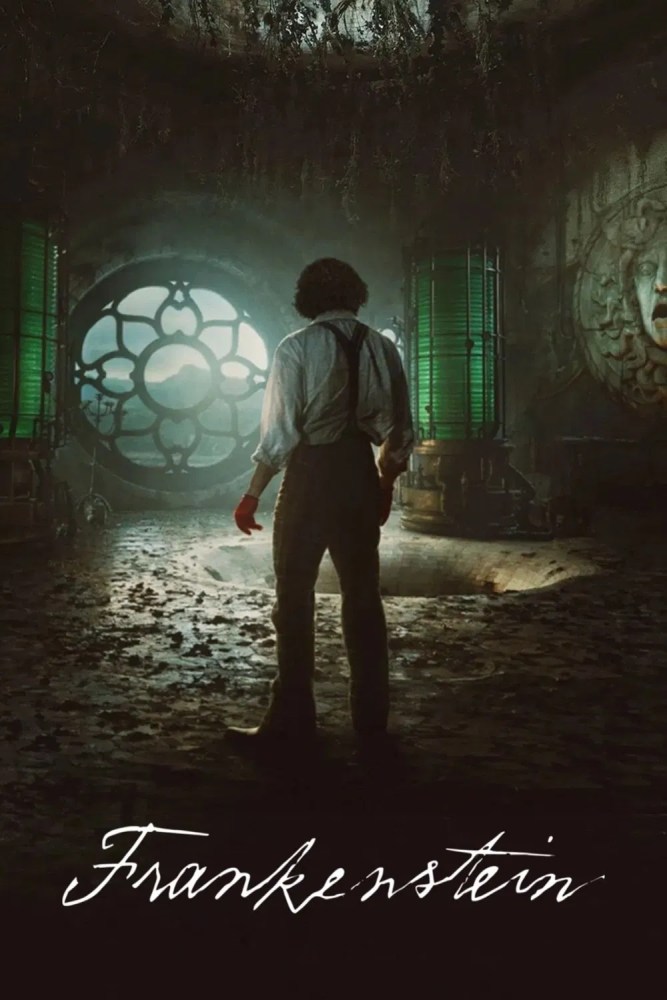

Director: Guillermo del Toro
Writer: Guillermo del Toro, based on the novel Frankenstein; or the Modern Prometheus by Mary Shelley
Cast: Oscar Isaac, Jacob Elordi, Mia Goth, Christoph Waltz, Charles Dance, Felix Kammerer, Christian Convery, Lars Mikkelsen
When I heard that Guillermo del Toro, one of the most imaginative and artistic horror/fantasy filmmakers ever to grace the film industry, was finally realising his dream of making his own Frankenstein movie, a story that is as monstrous as it is human, I was elated to say the least. Frankenstein + del Toro = a match made in hell heaven. Sure, there have been hundreds of film/television/stage adaptations of Mary Shelley’s enduring and heavily thematic novel, but if one was to consider del Toro’s filmography and general interests, one could easily argue that the man was born to make this story his own. Is it everything we could hope for from a filmmaker of both style and substance such as his, or perhaps it is closer to Frankenstein’s own abomination?
After losing his mother when she gives birth to his brother, young Victor Frankenstein (Convery) resolves to become a better surgeon with better knowledge of human biology than his own father Leopold (Dance), a renowned surgeon and abusive parent. Adult Victor (Isaac) indeed becomes infamous for his work in reanimation, to the point where he is commissioned by arms dealer Henrich Harlander (Waltz) to speed up the process and reanimate a full body. Once Victor succeeds, resulting in the ‘birth’ of his Creature (Elordi), everything begins to unravel as Victor comes to see his creation as an imperfect specimen, an abomination that must not be allowed to live.
del Toro’s career has led up to this film, and it has totally been worth the wait. His story does deviate in some ways from Shelley’s novel, most notably in Victor’s negative relationship with his father, which fuels much of his ambition alongside the death of his mother, but on the whole, del Toro’s version retains much of the same gothic flesh and thematic veins that have ensured the immortality of the story while successfully telling his own deeply emotional tale. Specifically, del Toro focuses less on the man-playing-God aspect and more on the responsibility of parenthood and nature versus nurture, starting with Victor and his father and moving through to Victor and his Creature. We have seen del Toro play with these themes before in his filmography (Pan’s Labyrinth) as well as other Frankenstein-centric topics, such as rejected creatures/anti-heroes (Hellboy, The Shape of Water) and life and death, whether it be the yearning for immortality (Cronos) or just for life itself (Pinocchio), and so it’s unsurprising that his Frankenstein is awash with a clear understanding of how these themes are interwoven and are the building blocks of the Frankenstein mythos.
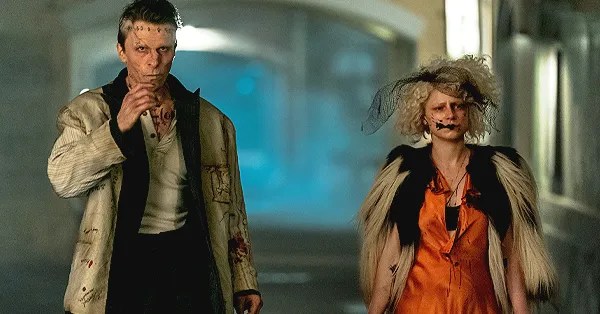
The production itself is on another level and may be del Toro’s finest vision to date. With stunning set design and imagery, the kind of gothic set dressing and physical builds we’ve come to expect of a del Toro production, we are fully immersed in the 1800s setting, a setting that adds a steam punk vibe to compliment the gothic, not to mention steam being part of the beginning of the industrial revolution, another incredible man-made feat that set us on a course for both success and doom. The design of the tower in which Victor conducts his experiments is utterly sublime and extremely well thought out; Victor spends much of his time on the upper levels, like a god on high, while his Creature, the devil, is cast out to the sewers below: “I ought to be thy Adam; but I am rather the fallen angel[…]”. The use of the colour red in both costumes and set dressing is, while perhaps a little on the nose at times, a stark reminder that death underscores much of the story. It is consistently used on and around Victor, while the alternative use of green and blue on his brother’s fiancee Elizabeth (with a dash of red, hinting at things to come) denotes who the representative of life is. The make-up and prosthetics, specifically the Creature’s, is wonderfully considered and carefully designed to make it different to other adaptations while still being recognisable as Frankenstein’s Creature. It makes him reminiscent of one of those biology models you find in labs and classrooms that are half outside the body and half within. It’s fascinating yet gory and repulsive. Add on to all of this the score by Alexandre Desplat, which gorgeously compliments the story and is a considered guide to the emotions experienced and reactions given by the audience, and our immersion into the story is cemented and becomes difficult to come back from.
When a filmmaker is making a film that they have wanted to make for a long time, or a story that was the reason they got into the industry in the first place, a lot is riding on it, but a lot is also placed on the shoulders of their chosen actors. Oscar Isaac was a wonderful choice for Victor Frankenstein, his ability to delve deep into the psyche of the character bursting forth in manic physical and verbal expressions, and even his English accent has improved substantially since Moon Knight. Mia Goth, for whom del Toro wrote the role of Elizabeth, gives a performance that is the most subdued we’ve seen her for some time (perhaps ever), so she becomes the antithesis to Isaac’s madness, a tonic that balances the entire tone of the film, and offers the warmth and kindness to the Creature that others, especially Frankenstein, are unable or refuse to. Christoph Waltz is understated in comparison to other roles he has had, but his performance works in tandem with Isaac’s to deepen Frankenstein’s madness as well as reflect it back to him at times, with Waltz giving that little twinkle of insanity that lies below the surface of Harlander. Finally, we have Jacob Elordi as the Creature, a role as synonymous with horror literature and cinema as the likes of Dracula and Pennywise the Clown. Elordi is (and forgive the pun) electric, effortlessly evoking visceral emotion through his physicality and his eyes until the Creature’s own part of the story, when the emotion becomes more cerebral and considered but no less palpable. His ability to visually portray so much before the Creature is even able to speak is astonishing. It also helps that he’s 6’5” (according to IMDb), meaning he looms over his co-stars just as the Creature is generally described and portrayed. Originally Andrew Garfield was set to portray the Creature, and while I don’t doubt he would have put in a great performance, Elordi absolutely smashed it, deserving of being recognised alongside Boris Karloff, Christopher Lee and Robert DeNiro.
When doing English Literature for my A-Levels, the syllabus included a term on gothic literature, in which we studied Dracula and Frankenstein. The most enjoyable part for most of us was when our teacher would wheel in the telly and pop on the VHS of Kenneth Branagh’s Mary Shelley’s Frankenstein, a great and fairly faithful adaptation of the novel that helped us visualise Shelley’s words. del Toro’s Frankenstein ought now to be included in studies of the novel too, whether in English Lit classes or film and media or drama classes, because there is just so much to unpack from both a literary and cinematic standpoint. There is so much more to be said and discussed about it, much more than I can express here though I cannot stop thinking about its imagary, symbolism and performances. It’s fantastical but grounded in reality, much like del Toro is known for, subtle in some respects, overt in others. del Toro’s entire body of work can be considered a prelude to this, and though I once considered The Shape of Water to be his magnum opus, could I have been wrong…? It will almost certainly be up for make-up and set design awards, but what about Elordi’s performance (could he do what others such as DeNiro could not?) or del Toro’s direction and writing? Could del Toro make it a double whammy and get another Best Picture Academy Award? All fingers, toes and available limbs are crossed that del Toro and his cast and crew get the recognition they deserve for this stunning production of pure gothic brilliance.
Frankenstein will be streaming on Netflix from 9th November.




 Dawn of the Tapes
Leave a comment