


Director: Danny Boyle
Writer: Alex Garland
Cast: Alfie Williams, Aaron Taylor-Johnson, Jodie Comer, Ralph Fiennes, Jack O’Connell
You may have heard of a little 1968 George A. Romero film called Night of the Living Dead. This film invented the zombie genre (as we know it) in cinema, and spawned multiple sequels and spin-offs (and parodies) in the decades since. Then, everything went a little, well, dead. Cut to 2002, and director Danny Boyle and writer Alex Garland premiered their own little zombie film, 28 Days Later. Considering its meagre budget (by film standards) and minimal release, it fared very well financially, particularly in the U.S, and critically. As a result, not only did we get a sequel, 28 Weeks Later (that was in fact released five years later) and comic books, but it resurrected (pun intended) the zombie genre. Now, we have had so many zombie-based films, TV shows, books, comic books and video games that it’s feeling saturated and tough to invent new ideas pertaining to the undead. Clearly, that has not deterred Boyle and Garland from revisiting their grown-up movie-child, but have they managed to do something fresh for the genre while remaining true to what they originally created, or was the franchise better off dead?
In 2002, the Rage Virus devastated the UK and made zombies of most of its human inhabitants. 28 years later, 12-year-old Spike (Williams) lives on an isolated island connected to the north-east of England by a causeway along with his scavenger father Jamie (Taylor-Johnson), his sick mother Isla (Comer), and a small community of other survivors. After embarking on a scavenger’s rite-of-passage with his father on the mainland, Jamie learns of a doctor who lives not far from the coast and is determined to find him to help his mother, in spite of his father’s warnings that the doctor is a dangerous man, and in spite of the apparently evolved infected that roam the land.
The first thing of note with this film is how much Boyle’s filmmaking has evolved in the twenty-three years since 28 Days Later. Years still bears many of his hallmarks, but he has refined his cinematic style, and the way he intersperses some poignant historical scenes with the present situation to reflect on humanity’s history is a little jarring at first but feels familiar of a Boyle film. However, the film has some losses, both in its visuals and story. The use of a camcorder back in 2002 gave Days its grittiness and realism, whereas the use of an iPhone 15 to shoot Years, along with drones and other more modern technology, doesn’t quite work in the same way that the previous films immersed the audience and made it fee like we were physically there with the characters. Likewise, the story takes a departure from the main focus of Days and Weeks, which is the virus itself. There’s no doubt that many will enjoy the pivot onto the people and how they are surviving, but then it becomes closer to every other zombie film/TV show out there. The virus created terrifying antagonists in the past; not so much anymore.
As this is supposed to be the first in a new trilogy, perhaps it could be forgiven for its shortcomings and will fare better once the story progresses, and there are some signs that show promise. For instance, the evolution of the virus and intelligence that appears to have grown within communities of infected is interesting, as is (without spoilers) the possibility of infected females reproducing. There also now appears to be an ‘Alpha’ of the pack (and he gives serious Predator vibes in both his physicality and the way he chooses to kill his prey), and with the addition of whatever it is the doctor is up to, there are a few things to look forward to getting answers to, including what appeared to be a preposterous, and even controversial, ending (see the end of this review for a spoiler-filled explanation).
Young Alfie Williams turns in a solid performance as Spike, his naïveté to pre-virus Britain and the world at large providing strong ground for Spike’s development. Taylor-Johnson adopts as close a Geordi accent as he can muster, but everything else about his performance doesn’t exactly scream ‘unique’. Perhaps it’s the character of Jamie himself, but there’s just not a lot to connect with. Comer on the other hand portrays a woman suffering from a mental and physical illness of some kind superbly, and her chemistry with Williams draws us in to their mother-son bond. Fiennes is a real standout in this film, an eccentric performance of a character that might otherwise feel unoriginal (eccentric, isolated, possibly misunderstood characters are two-a-penny in most post-apocalyptic situations).
Although we can expect more from this story (and soon, apparently), for the time being, 28 Years Later is not the strongest welcome-back to a popular franchise. You may also wonder why the film was written as ‘years’ later and not ‘months’, and that’s because Boyle and Garland had a falling-out while making 2007’s Sunshine, thus the years passed and by the time they made up, making ‘months’ seem pointless. ‘Years’ gives more time for things to have evolved one way or another and has more potential, potential that we haven’t seen the full extent of just yet.
***Spoilers ahead***
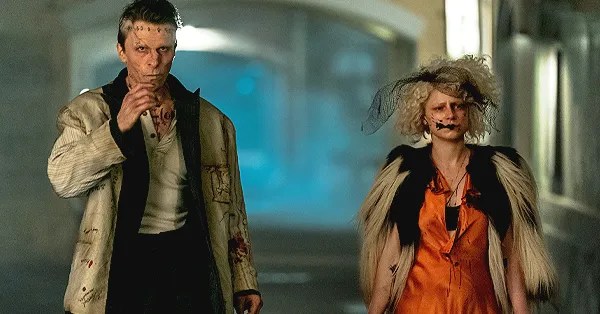
I cannot wrap my head around that ending, in which Spike encounters a group of survivors dressed like infamous British TV personality and accused paedophile Jimmy Savile, from his signature jogging suit to the unkempt blonde hair, with the leader being the young boy named Jimmy from the film’s prologue (the adult version played by Jack O’Connell), his name popping up at one other point within the film, too. Initial thoughts were, WTAF, and then on further thought, this is likely a world that never knew of Savile’s suspected crimes, as in reality they only came to light after his death in 2011 (as he is dead, it’s not possible to try and/or convict him of what he did, and so he stands post-humously as ‘accused’), and so he is perhaps still a revered icon of a bygone era. It must be doubly strange for non-Brits to understand the reference. In any case, there better be a damn good reason why such a horrendous person is used in this way.




 Dawn of the Tapes
Leave a comment