

Wes Anderson is a name synonymous with artsy cinema, an auteur known for following the same themes within his films and casting tons of familiar faces, many of which he has worked with multiple times. His films are studied and even influence other filmmakers, both seriously and in parodies sometimes. With his latest project, The Phoenician Scheme, having just hit cinemas, I decided it was time to visit (and in one or two cases revisit) his previous projects to see if there has been an evolution in Anderson’s filmmaking, or if his signature style is as consistent as critics and audiences say.

The Royal Tenenbaums (2001)
Writers: Wes Anderson, Owen Wilson
4/5
First up, the infamously dysfunctional Tenebaum family, in which patricarch Royal Tenenbaum, played by the late great Gene Hackman, attempts to reinsert himself in his estranged family’s lives and affections by falsely declaring that he is dying. It’s easy to see why this film was lauded upon its release and received all sorts of award nominations, including a Best Original Screeplay Academy Award nomination. It’s the kind of film that has some foundation in experience, mainly being from a dysfunctional and/or ‘broken’ family, but is then exaggerated in some aspects in an attempt to see the humour in some situations (resulting in some real laugh-out-loud moments) as well as bring forth the mental effects of such a family. The color palette, cinematography and direction that Anderson is well known for is already clear to see, as well as his choice of excellent actors. This is a great start and introduction to Anderson’s filmmaking.
The Life Aquatic with Steve Zissou (2004)
Writers: Wes Anderson, Noah Baumbach
3/5
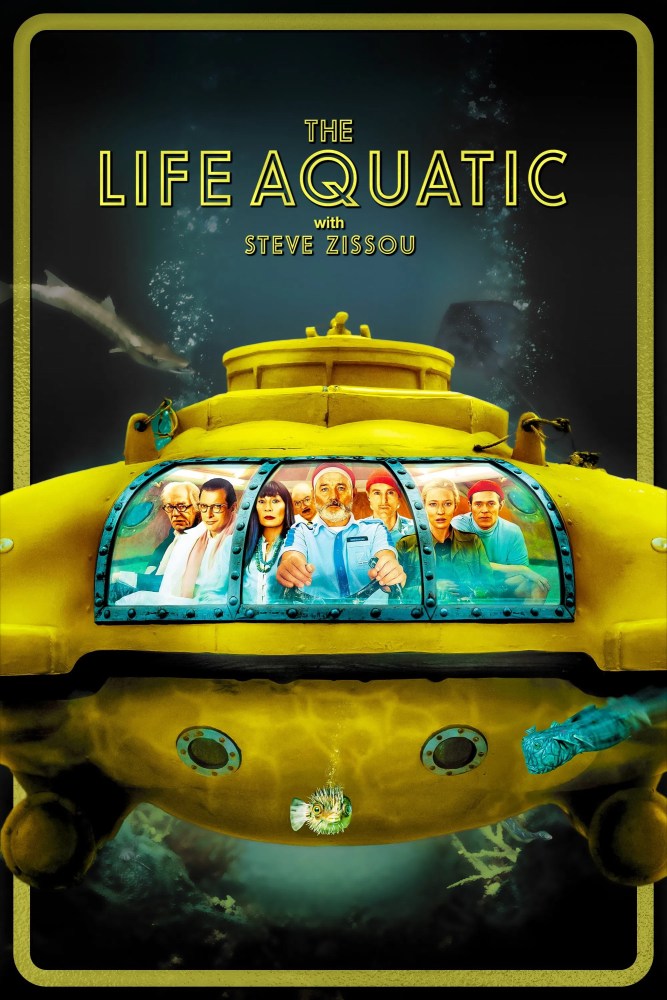
Anderson moves his dysfunctional family trope to a dysfunctional group of colleagues working for oceanographer and documentarian Steve Zissou (Bill Murray) as he seeks revenge on a shark for eating his friend. It was a little jarring watching this a day after The Royal Tenenbaums as it was hard to separate some of the actors from their previous characters, particularly considering some of them retain a similar personality. The story itself is a little flat, not having as much depth as Tenenbaums and the hunt for the shark not being that strong a motive. Having said that, it has a fun ensemble and a distinct vibe and visual charm to it, even if the vibe was different to what I’d always thought it would be (I was doing A-level media studies when this film was released and remember a poster of it hanging around and thinking it was going to be entirely underwater and/or set in a submarine). On the whole its a move that struggles to find its place between humour and emotion but has some charm to it.
The Darjeeling Limited (2007)
Writers: Wes Anderson, Roman Coppola, Jason Schwartzman
4.5/5
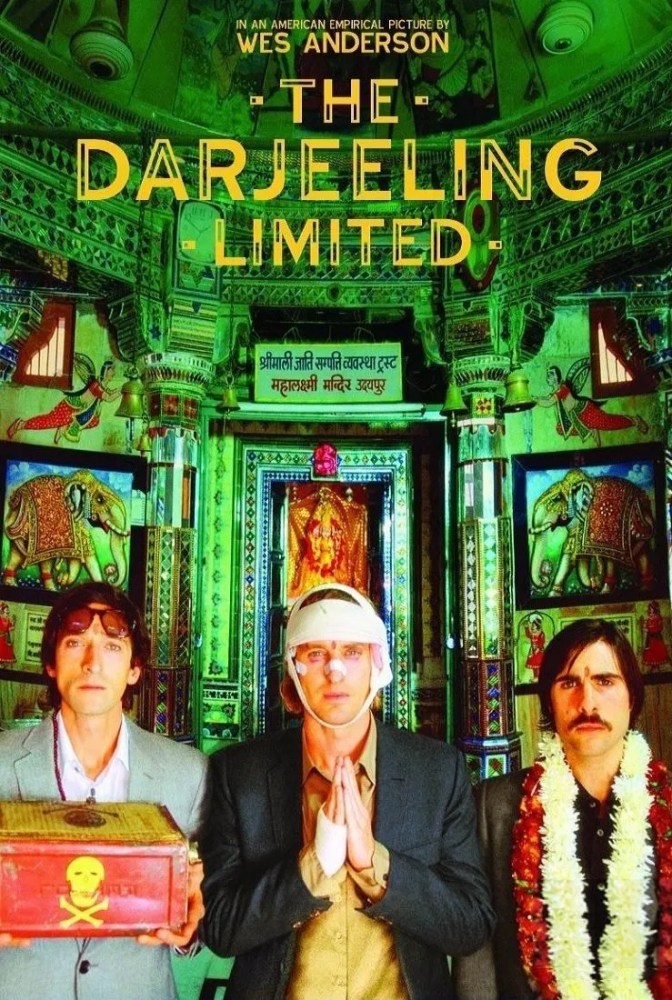
Something I am noticing about Anderson’s films by this point is that he is quite good at coming up with fresh settings for his familiar themes. Now we have three brothers trying to reconnect one year after their father’s funeral by travelling in India. Although a little less dysfunctional, the eye on the dynamics of a family, particularly a broken one, is still there, with the relationships between the three brothers (and eventually their mother) coming across as realistic and even quite natural at times, with excellent fraternal chemistry between Owen Wilson, Jason Scwartzman and Adrian Brody. The story manages to pull back more depth than The Life Aquatic had while balancing any humorous moments well (perhaps the influence of co-writers Coppola and Scwartzman?), and it is likely to resonate with anyone who has a less than perfect relationship with any siblings. It also has more streamlined cinematography than Anderson has captured previously, letting focus remain more on the brothers’ story and even letting the beauty of India speak for itself. So far, this is my favourite Anderson film.
Fantastic Mr. Fox (2009)
Writers: Wes Anderson, Noah Baumbach, based on the novel by Roald Dahl
3.5/5
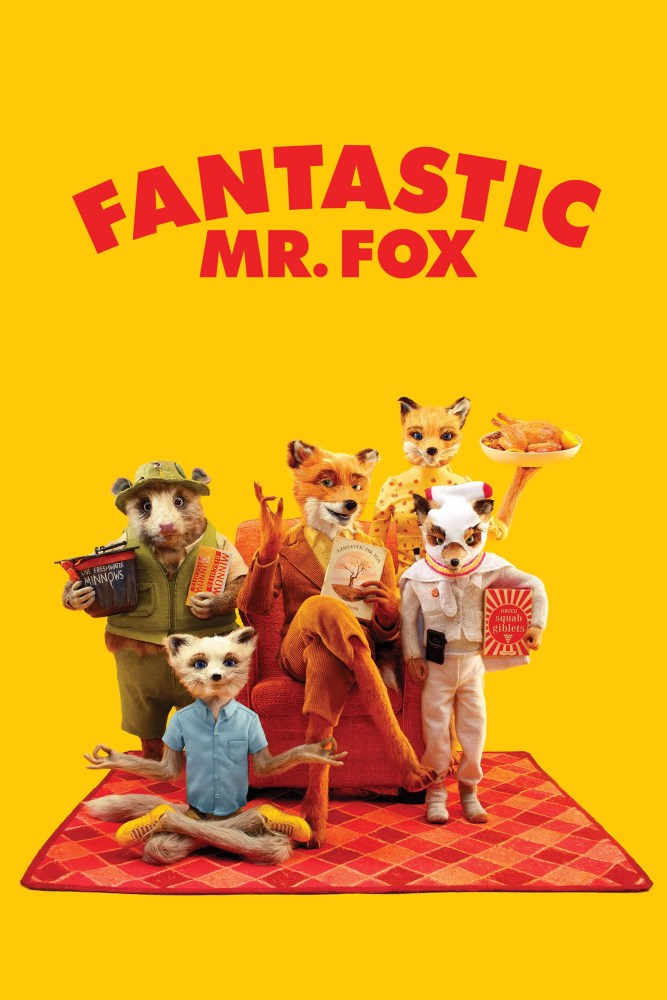
Fantastic Mr. Fox was certainly a staple in millions of childhoods (mine included) and so is very a familiar story. Anderson’s version follows much the same plot, that of Mr. Fox (George Clooney) and his daring escapades stealing food from farmers Boggis (Robin Hurlston), Bunce (Hugo Guinness) and Bean (Michael Gambon) to feed his family until the men start coming after him, but adds some extra scenes and replaces some characters. It’s an enjoyable adaptation and a nice digression from Anderson’s usual live-action, though it retains the same visual styling, dry dialogue and humour and a mostly familiar cast. At times the film can’t seem to decide who its audience is (Adults? Children? Both?) – the story is meant for children, but some may find Anderson’s style too dull for their energetic minds. Adults will appreciate it more, particularly those who enjoyed the book as children, though it does fall a little flat at time, becoming monotonous in both storytelling and performances.
Moonrise Kingdom (2012)
Writers: Wes Anderson, Roman Coppola
4/5
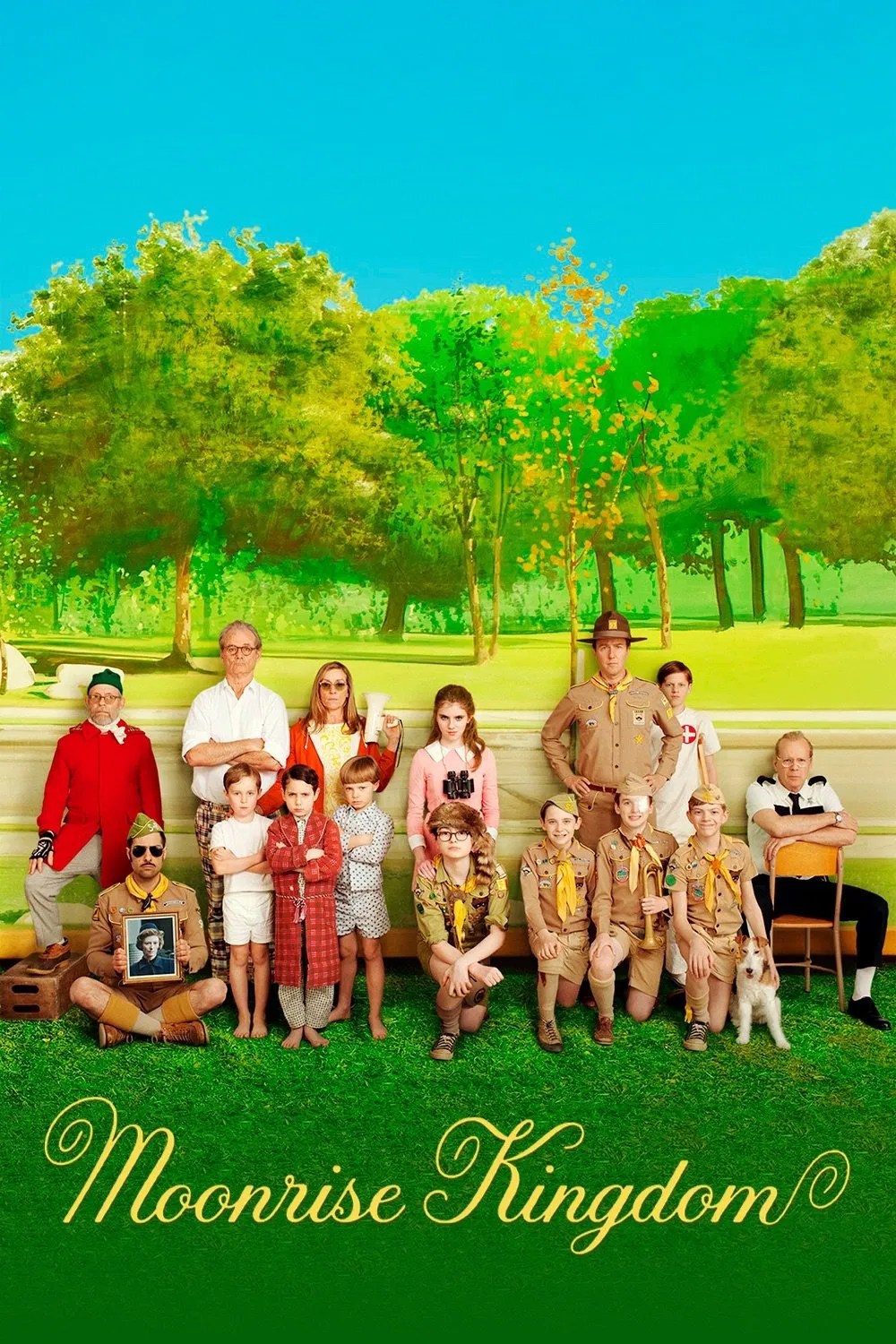
Anderson moves to focus on children and their first steps into the world of love. 12-year-old orphan Sam (Jared Gilman) meets 12-year-old Suzy (Kara Hayward), and they strike up a written correspondance. They soon fall in love and agree to run away together. It’s quite a sweet story overall, following a fairly solid plot, and the young actors are very, very good (including the extras and featured actors), though there’s not much to say outside of that, as Anderson’s films are very formulaic at this point. I can also understand the controversy that surrounded this film when it comes to how the young children are portrayed and found it a little off myself, and though Anderson did appeart to do his best to keep it as innocent as possible with nothing untoward behind it, some of it was probably unecessary. It’s an endearing film and may even be quite relatable for some, but it would have been nice to see something just a little different visually.

The Grand Budapest Hotel (2014)
4/5
This film I found to be quite interesting in both its plot and characters. Gustave (Ralph Fiennes) is the hard-working concierge of a large resort and a mentor to lobby boy Zero (Tony Revolori). When Gustave is framed for the murder of a wealthy dowager who resides at the resort, he and Zero set out to prove his innocence. The most enjoyable aspect of this film is Fiennes’s performance, a world away from some of his more serious roles. I probably don’t have to mention anything about the extensive cast, as we are used to this by now with Anderson’s films, but it’s good to see some newer faces amongst his more frequent casting choices, particularly the likes of Revolori and Saoirse Ronan. The story itself is captivating and the settings quite interesting, keeping things as fresh as possible amongst Anderson’s standard style.

Isle of Dogs (2018)
3/5
In Anderson’s second animated feature, he takes inspiration from Japan and attempts to take back all the wrongdoings he’s commited against animals in his previous features. The mayor of Megasaki, a fictional city, banishes all dogs to an island after an outbreak of a disease. When his nephew discovers his dog has been sent to the island, he goes after him, while others try to out the mayor as a corrupt individual who hates dogs and hides a secret cure for the disease. As far as the animation goes, it’s charmingly done and does a great service to the stop-motion form, but after a while it starts to feel somewhat tiresome, like it’s gotten too uniform. Perhaps it’s down to the restrictions of shooting in stop-motion, perhaps it’s down to Anderson’s own choice in direction, either way it doesn’t feel right for the direction the film takes. As it becomes more emotional, it feels like the shots and editing should smoothen and become less rigid. The emotional turn is still there, thanks to the vocal performances and animation, but the direction makes it difficult to empathise with the characters.
Read the full Isle of Dogs review.

The French Dispatch (2021)
aka The French Dispatch of the Liberty, Kansas Evening Sun
3.5/5
You better be prepared before watching this film, as there’s quite a lot going on, though Anderson does break it up as an anthology. Four stories are told as part of the final issue of a magazine following the death of its editor along with an obituary, all stipulated in his final will. The anthology format makes the most sense for Anderson, as his projects tend to be blocked in acts or chapters anyway, and it helps to focus on one particular story and cast at a time rather than an amalgamation of multiple. It’s also more colourful on the whole, perhaps to offset certain scenes depicted in black and white, which is a welcome change of pace. Once again, Anderson has picked an insane ensemble of actors, including frequent Anderson actors, as always. Unfortunately not every story is all that interesting, so it’s a bit hit and miss overall.

Asteroid City (2023)
3/5
Continuing this current trend of fairly average films, Asteroid City is a strange story stemming from a small asteroid and the town that surrounds and the existance of aliens, and it is framed as a play of sorts, the making of which is also presented via a television show. If that sounds confusing, that’s because it kind of is. Multiple actors play dual roles as characters and actors of the characters, causing confusion if you’re not paying close attention, and the multiple storylines and weaving in and out gets a little much by the end. In spite of this, once again the performances are top notch with fine casting and a huge ensemble.
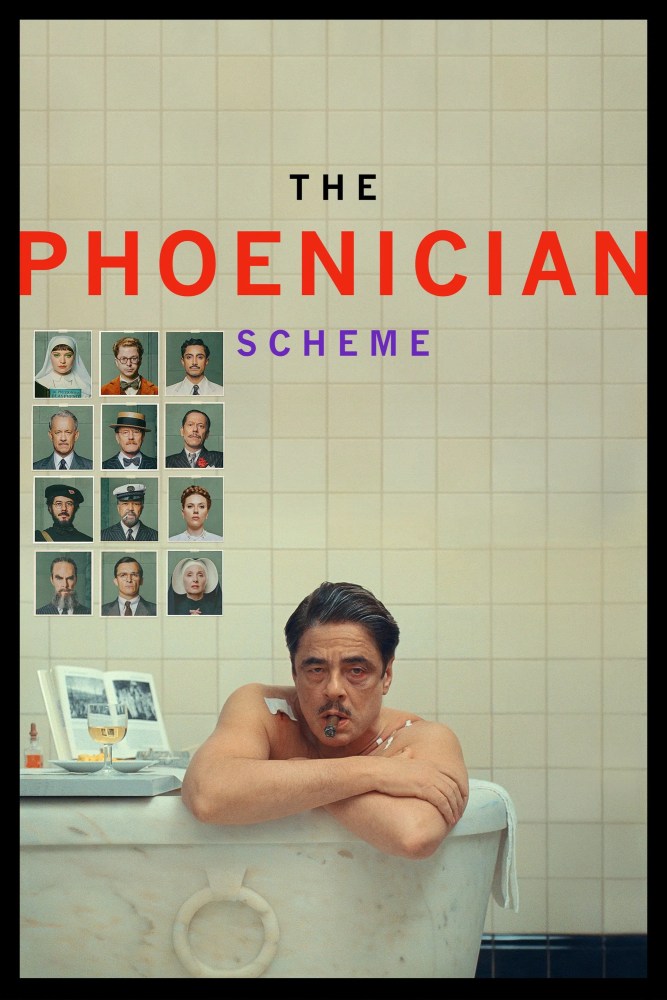
The Phoenician Scheme (2025)
Writers: Wes Anderson, Roman Coppola
3.5/5
If you were hoping Anderson’s latest would offer up something a little different, a little more refereshing, you may be disappointed. If you are a bigger Anderson fan, you may get a lot out of The Phoenician Scheme.
Read the full The Phoenician Scheme review.

If there’s one thing that can be said about Wes Anderson, it’s that he is a consistent filmmaker, an auteur who is loyal to his own style, vision and collaborators. It is entirely his prerogative to make his films the way he visualises them, and there are many who enjoy them for that reason. It does however become monotonous after a while and difficult to write about, as many aspects become repetitive. It began to work better when he varied the lead actors and relegated frequent collaborators to secondary roles or bit parts and took on other actors, particuarly of the younger generation. His stories are up and down, his better ones usually in collaboration with Roman Coppola and/or Jason Schwartzman, but at least no two are the same and are, on average, very imaginative (sometimes getting away from themselves). If you were to embark on your own journey through the Andersonverse, I would suggest giving some breathing room between each film rather than watching them too close together so you won’t feel too tired out by the same thing, but I do recommend checking them out, if that should be in whatever way you want. I for one hope that we could see something a little different from Anderson in the future, but I won’t hold my breath.

 Dawn of the Tapes
Leave a comment