
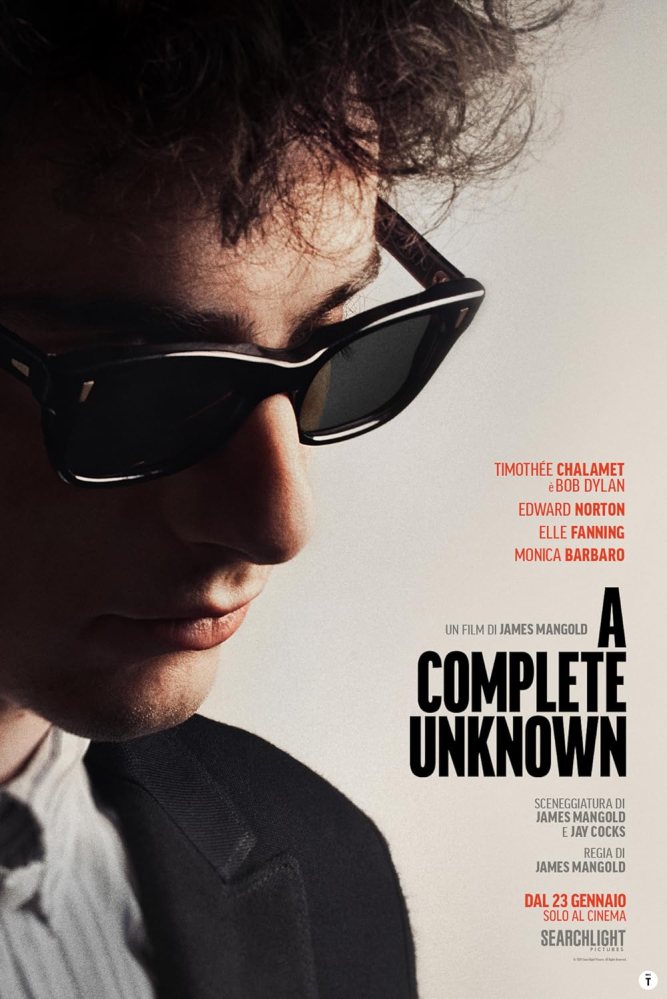

Director: James Mangold
Writers: James Mangold, Jay Cocks, Elijah Wald
Cast: Timothée Chalamet, Edward Norton, Elle Fanning, Monica Barbaro, Scoot McNairy, Albert Grossman, Boyd Holbrook
As I’m sure I’ve mentioned in other reviews of films of a similar ilk, biopics of famous people, particularly musicians, have become popular fodder for filmmakers. It makes sense for some famous faces to have their lives committed to film, as their experiences are often truly stranger (or more hedonistic and fantastical: see Elton John and Freddie Mercury) than fiction and thus make for solid… erm… entertainment. The common vein that runs through biopics of musicians is, of course, the music, their artistry, and their artistic process in all its ugliness and beauty. None are perhaps more intriguing in this arena than the legend that is Bob Dylan, a rather private individual who made his mark on music the minute he began to put his songs out there. Has James Mangold managed to uncover some facets of this notoriously private musician to brighten the shine on his star, or are we left as clueless as ever?
In 1961, twenty-year-old Robert Zimmerman, aka Bob Dylan (Chalamet) makes his way to New York City to visit his idol Woody Guthrie (McNairy), who is in the hospital with Huntington’s Disease. While there, he befriends Pete Seeger (Norton), and he is introduced to the folk music scene in New York, where he also meets love interest Sylvie (Fanning), and fellow folk musician Joan Baez (Barbaro). Dylan’s name and face begins to gain interest as he performs his songs to adoring audiences, and amidst the tumultuous sea of celebrity life versus private life, he starts to become disillusioned with what is expected of him and attempts to branch out of folk and into a heavier sound.
As biopics go, this one is probably on the lighter side of dramatic, as Dylan’s younger life was a tad less dramatic and drug-fuelled than most of his contemporaries and spiritual descendants, but that doesn’t mean it is any less appealing or fascinating. Dylan really was a natural-born talent when it came to music, with his lyricism and ability to tap into the human spirit, especially concerning Americans amid the backdrop of the assassination of JFK and a lot of political and social unrest in the early 60s. The post-war years still had people on edge and protesting and speaking up, and Mangold managed to capture much of this extremely well, providing an understanding of where Dylan was getting a lot of his inspiration. Throw into that a fairly messy love life and there was certainly enough for a story that offers some context behind Dylan’s artistry and his eventual need to branch out as times began a-changin’.
On the other hand, where there was a lot of focus on Dylan’s environment and the effect it had on his songs, there was less focus on his actual songwriting process. We are only offered glimpses here and there of him developing his songs, which feels like a missed opportunity to delve deeper into Dylan’s artistic growth. Having said that, Dylan is known to lead a more private life, therefore perhaps it was a way to keep audiences at arm’s length, in a similar way he kept his muses and audiences at a distance. The musical performances themselves were wonderfully shot, with the smaller shows permeating with intimacy and the larger shows feeling more exposed, perhaps how Dylan himself felt. Much of the film vibrates with what we feel emanating from Dylan, seeing as he was reluctant (within the film) to expose many of his deeper thoughts verbally (unless it was through anger), and so we take what we can from his body language and songs.
It’s incredibly clear to see just why Timothée Chalamet has been so lauded for his performance as Bob Dylan, arguably the best performance of his career so far. His mannerisms and voice are on point, the hair, make up and wardrobe an uncanny likeness, and his musical performances are astounding. He conveys so much through his eyes alone that the dialogue almost becomes unecessary at times. Chalamet put years of his life into preparing for this role and it very much paid off. The awards and nominations are well-deserved indeed. Likewise, Barbaro as Baez is a treat to watch onscreen, her performance fantastic but her vocal performances being specifically enchanting. Norton’s Pete Seeger is a tonic throughout, a buoy in the stormy seas of Dylan’s life, and he also provides excellent musical performances. Fanning’s performance as Sylvie provides some relatability and grounding to the film, and Holbrook’s understated performance as Johnny Cash adds a little humour and understanding of the level of celebrity that Dylan had reached at that point in time. Special mention to Scoot McNairy who gave an emotional performance as the ailing Woody Guthrie that must have been quite difficult.
Other than what he lets us know through his music, Bob Dylan is a bit of an enigma, and although A Complete Unknown let’s us peek into an integral chapter of his life, we’re still pretty much on the outside, and I think that’s where we ought to be. A magician should never reveal his secrets, and what Dylan has created over the decades is, indeed, pure magic, as is this gem of a film.




 Dawn of the Tapes
Leave a comment