
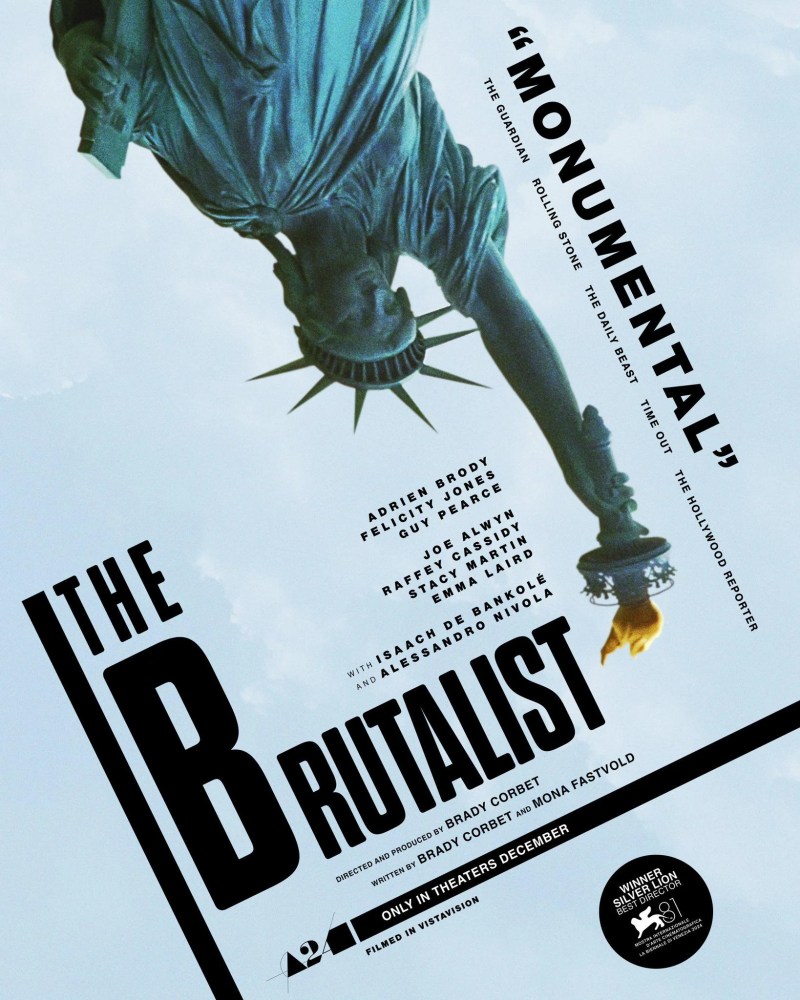

Director: Brady Corbet
Writers: Brady Corbet, Mona Fastvold
Cast: Adrien Brody, Felicity Jones, Guy Pearce, Joe Alwyn, Raffey Cassidy, Stacy Martin, Isaach De Bankolé, Alessandro Nivola, Michael Epp, Jonathan Hyde, Emma Laird
In the post-WWII world, millions of people were trying to process their grief and trauma from the war in various ways, one of those being through architecture. Whether it be in colours and shapes or bright spaces and locations, there was a lot of optimism to be seen, particularly in areas that had to rebuild after bombings. There were also less optimistic styles, such as one known as Brutalism, a very cold, minimal, open-space kind of style that lacks colour and decoration. Brady Corbet’s film, while taking the style as its title and the protagonist’s main style of work, is brutal in far more ways than one. The post-war diaspora of people, particularly Jews, that came out of Europe had an incredibly tough time, a cruel fate for people who had already suffered so much. So, how does The Brutalist fare in its depiction of life, and navigating a new world, for those whom life could never be as it was?
In 1947, Hungarian-Jewish architect László Tóth (Brody), a survivor of the Holocaust, joins his cousin Attila (Nivola) in New York City, where Attila has promised him a bed and a job. However, László soon finds himself working for and living in close proximity to Harrison Lee Van Buren (Pearce), a wealthy industrialist with a temper, who commissions László to build a community centre in honour of Van Buren’s late mother. He also assists László in bringing his wife Erzsébet (Jones) and niece Zsófia (Cassidy) to the States, László having not seen them since they were separated and sent to concentration camps. As determined as László is to make a new life for himself and his family, he quickly learns that the “American dream” is but that, just a dream.
Well. Where to begin. To many of us (speaking mainly to millennials), we have always known director/co-writer Brady Corbet as Alan Tracy in 2004’s Thunderbirds live-action film. But now, after a handful of other behind-the-camera projects since 2008, Corbet has become a bona fide filmmaker in his own right, culminating in something that is going to go down in the annals of film history. The research and humanity that has gone into the script, which was co-written by his partner Mona Fastvold, is expressive and strives for optimism where it is severely lacking for László, where it was often lacking for many Jewish immigrants. Make no mistake, Corbet and Fastvold have not shied away from the continued cruelty of life for a Jew post-1945, not even one as decorated in his home country as László; life has been brutal, many of his new experiences are brutal, and, of course, the results of his work are brutal to reflect all of this.
Corbet’s eye for detail, along with the talent of his cinematographer Lol Crawley, creates a visual marvel that often reflects László’s architectural work and state of mind as a pair, but also tries to push away the Brutalist aspects at times, trying to find the light in the dark. This is never more obvious than in scenes that take place abroad, where the architecture is perhaps more pleasant to behold, and yet darkness seems to continue to follow László. Part of what keeps this film interesting is the visuals, not just where human characters are involved, but where the buildings become characters themselves. Architecture has always reflected human emotion in one way or another, and Corbet understands this and utilises it often in his framework. The blend of the work of multiple architects to create László’s own designs makes something unique for this film yet recognisable enough to be grounded in realism and keep us attached.
If Adrien Brody does not scoop up most Best Leading Actor awards at all the events, then something is extremely wrong. His performance is intoxicating, dominating every scene he is in because László is a monument himself, whether he is laughing, crying, angered or quietly focused on his work, there is never a misstep. When it comes to Felicity Jones, Part One of the film builds a determined yet timid picture of Erzsébet in the minds of audiences, but Part Two brings a much stronger character, one that keeps László on his path, and Jones is fantastic in this turnabout., her performance every bit as potent as Brody’s. Guy Pearce’s performance is very good, even if Van Bruen’s dialogue slows down a scene or two, though it’s brief and quickly returns to form. The character initially appears to be solid grounding for László, but Pearce keeps a tone that is a reminder that something doesn’t quite sit right with Van Bruen, becoming quite harrowing as events play out. Stacy Martin and Joe Alwyn are a set of good and evil twins, with Alwyn’s performance being particularly disturbing at times and Martin’s providing the balance, and Cassidy’s Zsófia, while mute for much of the film, plays a part that proves to be a quiet representation of sinister actions and unspoken pain.
The Brutalist is up there with other epics and Best Picture winners (The Ten Commandments, Ben Hur, Schindler’s List, to name a few) in its grandeur. Did it need to be 3.5 hours long? Yes, absolutely, and it does not drag or feel overlong at any point. Corbet’s work on this film is stunning, from the script to the cinematography, the performances to the set design, everything screams ‘Best Picture’, but not forcibly: this film was not made to be a Best Picture winner. It was made to honour those who suffered similar fates to, and worse fates than, László Tóth to make life better for those around them and those who would come after them. As many have already said, this truly is a monumental film, and deserves all of the praise it is receiving.


 Dawn of the Tapes
Leave a comment