
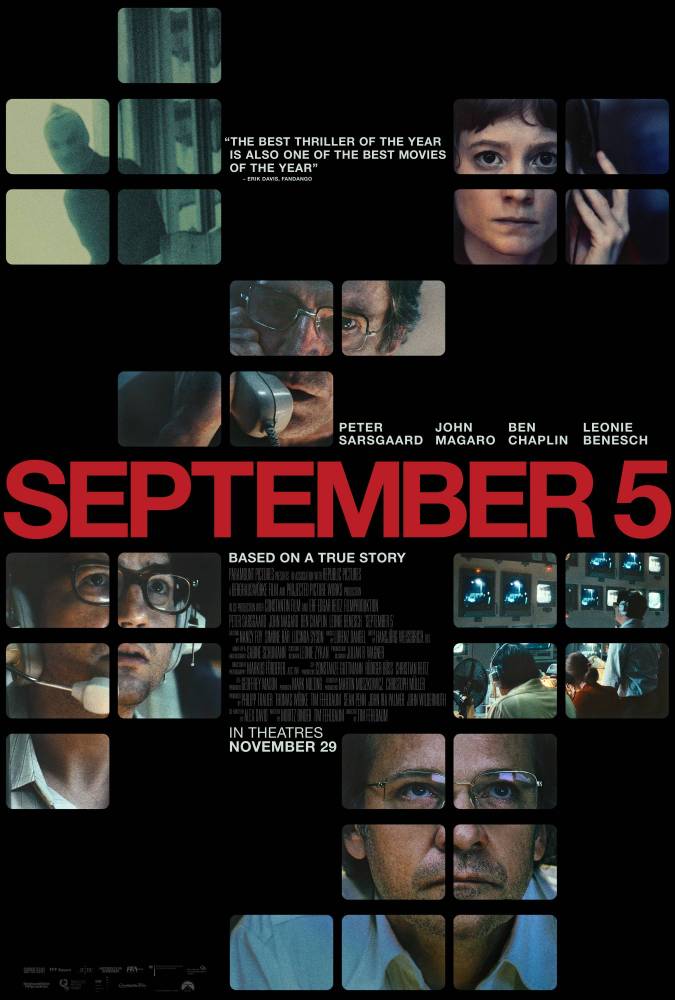

Director: Tim Fehlbaum
Writers: Moritz Binder, Tim Fehlbaum, Alex David
Cast: Peter Sarsgaard, John Magaro, Ben Chaplin, Leonie Benesch, Zinedine Soualem, Georgina Rich, Corey Johnson, Benjamin Walker, Marcus Rutherford, Daniel Adeoson
Holding the Olympics of 1972 in the city of Munich was a way to ease Germany back onto the world stage post-WWII, showing a unity with the rest of the world that it had previously lost. The Olympics did indeed put Germany in the spotlight, but for all the wrong reasons. Terrorism has always existed in one form or another in civilisation, but on September 5th, 1972, a terrorist act was broadcast on television for the first time, raising all kinds of ethical questions. As this horrendous time in history is given the film treatment, does it truly convey what it must have been like behind the scenes for those reporting, or does it push truth aside in favour of poetic license to exaggerate and gloss over real events?
During the Munich Olympics of 1972, an ABC Sports crew work around the clock to bring the latest competitions and results to viewers in America. However, their work is interrupted very early on the morning of September 5th, as gunshots are heard somewhere within the Olympic village. As news of the Israeli Olympic team being taken hostage by the Palestinian militant organisation Black September spreads through the village like wildfire, the Sports crew, reluctant to hand the story over to the regular news team back in the States, take it upon themselves to get into the thick of it. In doing so, they unconsciously put a rescue operation at risk and even announce updates without being thorough with sources in a bid to be the first to break the latest news.
There have most certainly been many movies that have taken a real-life event or situation, particularly a negative one, and blown it up for entertainment purposes, sometimes straying too far from reality. September 5 does not come across that way in the slightest. It appears very well-researched, from the setting of the control room at the Olympics itself down to the sequence of events and not shying away from the failures of the German police and the news coverage. It begins by setting a tone that underscores much of the film, that being the aftershocks of WWII still being felt by many, and the dialogue throughout being more poignant because of this. Then, as soon as the news breaks of the hostage situation, the tension begins to build like the beginning of a rollercoaster, and once it gets to the top and drops, something else happens to increase the tension once again. It is also keenly felt within the control room, as some insist the team tread carefully and sensitively while others push for getting the news out as soon as it comes in. Ultimately, they are trying to navigate new ground: recording an important unexpected event in real time for the first time in television history, and we are in the thick of it.
The film is shot extremely well, giving the audience the sense of being in the near-claustrophobic control room and being part of the situation, adding to an already gripping scenario. Original footage from presenter Jim McKay’s reporting is used rather than recreating it and using an actor, edging the film as close to reality as it could possibly get. The set design outside of the control room is fantastic and makes the whole thing very immersive, and the subtlety of the scoring is intentional and works in tandem with the visuals to keep the pressure on. Add all of this to an already expressively written story with purposeful dialogue, and you’ve got one hell of a dramatisation.
The performances also go a long way to create a cohesive story, something that is not easy when there are multiple characters to keep up with. Magaro’s performance as head of the control room Geoff Mason is fantastically multi-faceted, as Mason’s devotion to his job battles with his morals. Straddling either side of said battle are Sarsgaard as Roone Arledge, president of ABC sports, and Chaplin as Marvin Bader, the head of operations, one erring on the side of ethics (Bader) and the other on the side of reporting (Arledge). Both Sarsgaard and Chaplin portray their respective characters with clear understanding as to what’s at stake. Benesch plays German translator Marianne Gebhardt understatedly, which works well to juxtapose the sexism and prejudice she endured with just how important she was to the ABC team.
Putting events such as those of September 5th onto the big screen can bring about a lot of criticism, particularly if released during a time when tensions have risen once again, however it’s important to keep the memory alive, not just to remember the event, but the innocent people who lost their lives (I had barely heard of this before the film was released). September 5 is one of those films that does just that but also doesn’t gloss over the mistakes made and the human conflict that lies both within politics and within us when it comes to moral obligations. It’s a story that will have you on the edge of your seat for the majority of the time and perhaps thinking about what you would do if you ever found yourself situated between your ethics and your duty.





 Dawn of the Tapes
Leave a comment