
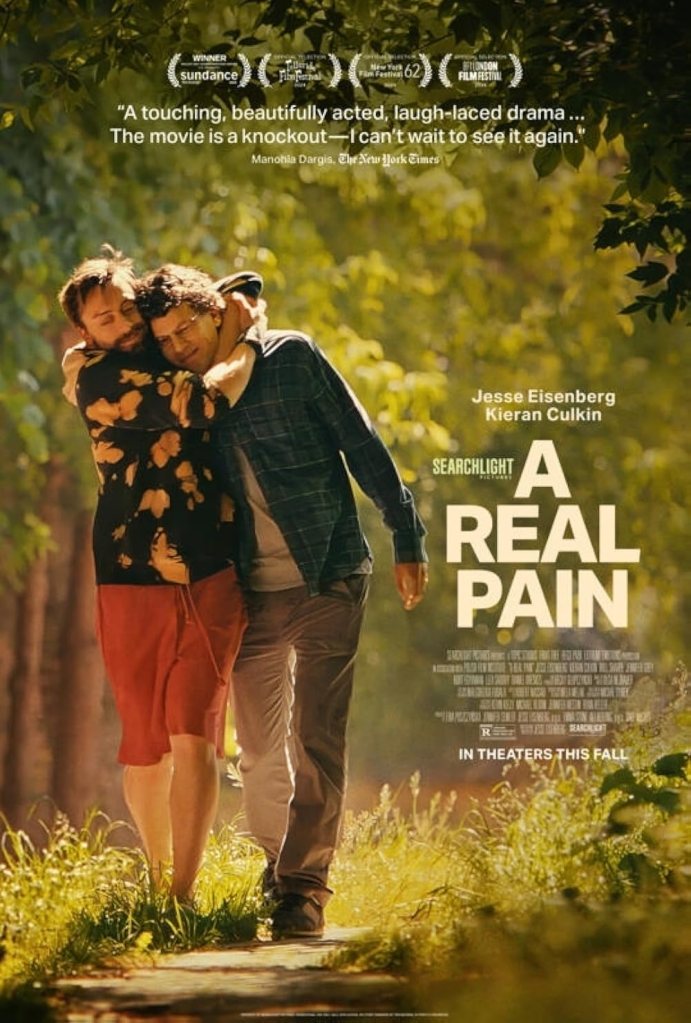

Director: Jesse Eisenberg
Writer: Jesse Eisenber
Cast: Jesse Eisenberg, Kieran Culkin, Will Sharpe, Jennifer Grey, Daniel Oreskes, Liza Sadovy, Kurt Egyiawan
Quite often, when a non-American speaks to a white American (specifically from the US) about heritage, the American will often divulge their ancestry that usually consists of something European, or, more commonly, multiple European connections. I’m not sure about other nationalities, but us Brits admittedly often roll our eyes at this, thinking that, after two, three, four, or far more generations removed, it hardly makes Americans even remotely connected to their European ancestry anymore. But the truth is, aren’t they just trying to understand what it really means to be ‘American’? It’s not an ethnicity, not like being Native American, so what do the descendants of immigrants, or asylum seekers, or, as many will relate to, the descendants of colonisers, class themselves as? Particularly, how can the descendants of those who experienced the pain and horrors of war reconcile that past with their present? That’s a more interesting conversation to have with Americans, rather than offering an eye-roll. In A Real Pain, Jesse Eisenberg has sought to connect himself with his Jewish/Polish ancestry by mixing fictional characters with a heck of a lot of reality. Has he successfully delved into the fraught history of an ancestry he shares with millions of Americans, or is it just another American film that uses the past just for the sake of a film?
After the death of their Polish grandmother, cousins David (Eisenberg) and Benji (Culkin) take a trip to Poland together to honour her. Having grown up as close as brothers, they had drifted apart in their adulthood and become very different people: David with his wife and child, stable job and deep anxiety, and Benji, seemingly happily floating through life, charming everyone he comes across, yet unsure of what to do with himself and struggling mentally with their grandmother’s death, with whom he was very close. On the trip, which starts with a tour group until they venture by themselves to their grandmother’s childhood home, the pair rediscover their brotherhood through outbursts and shared tokes of weed on rooftop buildings, both trying to understand each other and what their shared familial past means to them.
There will likely be thousands, if not millions, of people, certainly Americans, who will relate to this film. So many share the sadness of what their ancestors suffered for their freedom, and it often comes with an inner battle between respecting the sacrifices their ancestors made while enjoying the freedom and opportunities that their sacrifices were for. Eisenberg understands this better than many, it seems, as his film deftly explores that inner turmoil, equally split between David’s want to enjoy what Poland and his own life have to offer, and Benji’s despair at what the Jewish and Polish people went through and his struggle to understand how people can go on living, almost to the point of forgetting, after the worst has happened. The relationship between the two men is so wonderfully written, and so heartfelt that it could only have been performed by Eisenberg himself, and an actor of excellent calibre such as Culkin, even if he hasn’t a lick of Jewishness within him. The dramedy of it all works perfectly to again balance that darkness of the past with the light of the future.
Production-wise, it was certainly the right call for the film to be shot on location in Poland, giving the film its authenticity and connecting the audience to poignant locations. While it does feature important monuments, museums and memorials, Eisenberg worked to keep the tone generally light (not an easy thing to do when scenes involve places where so many were killed), using the music and mostly colourful vibrancy of Poland, a side of the country we don’t often get to see in films, to perhaps remind audiences that, in spite of its devastating history, if a country can rise from the ashes, so can its people and others around the world. Eisenberg reminds us to not only look back from a personal perspective in order to remember and reflect, but to also look forward through the perspective of others, something he makes clear in dialogue between Benji and the tour guide, James (Sharpe), as well as within David and Benji as characters.
As mentioned, this film, as well-written as it is, perhaps wouldn’t have been as affecting if it weren’t for the talent of the actors. Eisenberg brings his vision to life well as David, likely pouring some of himself into the character. The emotional ups and downs are thoroughly believable and even visceral at times. Culkin gives a depth to Benji that not many actors could portray, sometimes using nothing but his eyes and body language to convey so very much within Benji. He balances Benji’s cringiest moments with moments of genuine thoughtfulness, and toes the line between disrepect and good intentions. Sharpe is very good as the tour guide, making audiences feel part of the tour and learning some very interesting facts. The supporting actors round out the tour group wonderfully (Grey’s involvement was a surprise for such a small role, but it’s likely her personal connection to the subject matter that brought her onboard), with Egyiawan’s performance being particularly significant, offering an alternative point of view.
The very human need to connect with the past is something that will never go away, and for some, it’s purely a part of their life. Eisenberg’s film can help people to not only understand themselves and their feelings toward where they come from, but can help other’s to understand those people who may feel displaced or in need of connection. It’s an incredibly thoughtful film that, while not completely perfect, is as important as any other that works to reconcile the past and the present to, hopefully, build a better future while respecting those who gave it to us.





 Dawn of the Tapes
Leave a comment