
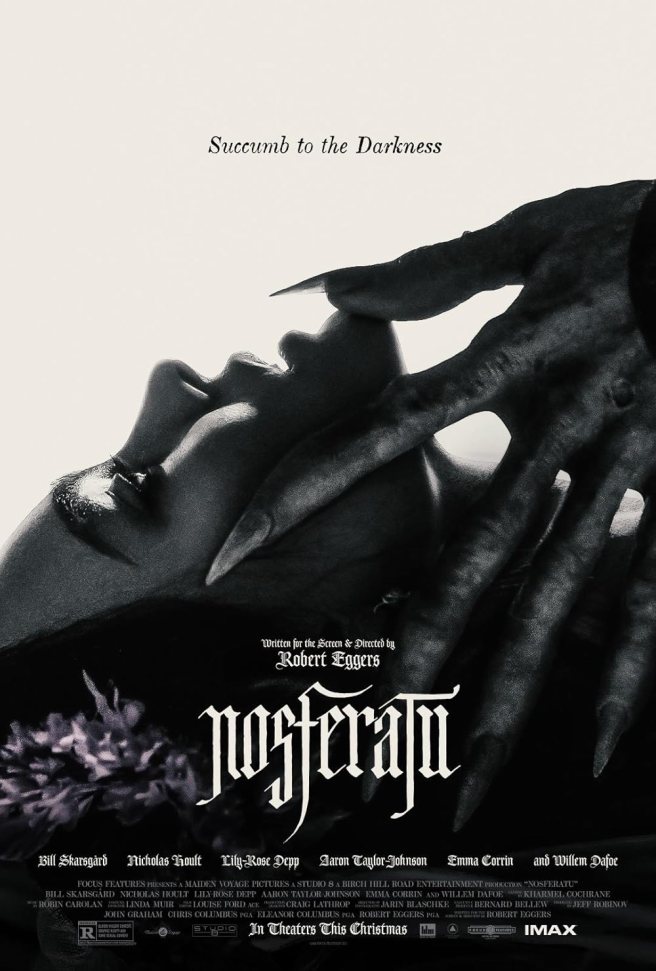

Director: Robert Eggers
Writer: Robert Eggers, based on the screenplay by Henrik Galeen and “Dracula” by Bram Stoker
Cast: Lily-Rose Depp, Nicholas Hoult, Bill Skarsgård, Aaron Taylor-Johnson, Emma Corrin, Willem Dafoe, Ralph Ineson, Simon McBurney
Nosferatu. The name is synonymous with shadowy images of vampires and darkly atmospheric scenes. Many will recall the F.W. Murnau picture of 1922, some the Herzog 1979 remake, and others the many adaptations of Dracula from over the past century. Now, director Robert Eggers brings the legacy of the vampyre into the 21st century for one more remake/adaptation. Nosferatu: A Symphony of Horror of ’22 is a staple in cinematic education and lore, and Nosferatu the Vampyre of ’79 proved that remakes can actually be good. Has Eggers managed to continue the trend and bring us something that appeases Nosferatu fans while impressing and gaining a new audience, or should the Count have been left to his eternal slumber?
Soon after their wedding, Thomas Hutter (Hoult) leaves his wife Ellen (Depp) alone in Germany to journey east to Transylvania. There, he meets the decrepit Count Orlok (Skarsgård), to whom he delivers the papers to a dilapidated castle the Count has bought in Germany. While Thomas is gone, Ellen suffers from seizures and strange visions, with Thomas having left her under the care of their friends Friedrich (Taylor-Johnson) and his wife Anna (Corrin). When Thomas returns, he has become aware of the dark nature of Count Orlok, and he is disturbed to find his wife is already aware of the Count’s desires and his thirst for blood.
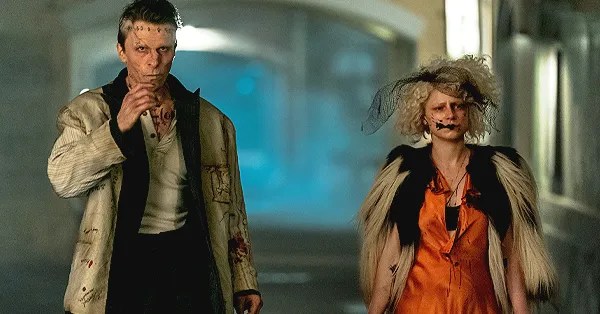
The 1922 Nosferatu is indeed a cinematic treasure, a distinctive expressionistic masterpiece in spite of its birth from Dracula, and the 1979 Nosferatu the Vampyre is an elegant, frightening reimagining that blends both Nosferatu and Dracula to become, in turn, its own unique gem. Thus, taking on something that is well-beloved is never an easy decision. However, putting it in the hands of someone such as Eggers, a filmmaker with a keen interest in vampire lore, a personal history with Nosferatu, and someone who has shown his own deft hand at folk horror (The Witch) and creating an intimidating and stylistic atmosphere (The Lighthouse), was most certainly the correct choice. He utilises the silhouettes that are most recognisable from Murnau’s film (perhaps a little too much at times) and invokes the dark atmosphere quite hauntingly, while also juxtaposing the dark feralness and elegant imagery that made Herzog’s film so eye-catching. But what actually separates Eggers’s film, Count Orlok in particuarly, from previous incarnations is the Count’s dialogue (he certainly has far more than ever before, and it makes him that much more menacing); the costuming and make up (terrifying, believable and grounded in real history); making the sexual themes more overt rather than subtextual (the day and age we live in certainly allows for such freedom in film); and making no mistake that this iteration of the Count is absolutey pure evil.
Eggers reunited with frequent collaborator Jarin Blaschke on the cinematography, and what a bleak and evil ambience did they create. Between Eggers’s direction of his actors, Blaschke’s unique framing and camera movements (the frequent panning makes for extra dramatic, edge-of-your-seat scenes) and the overall set design, it is a visual treat for horror fans and constantly provides a feast for the eyes. Where Murnau’s film was visually expressionistic and Herzog’s a gothic horror that blends the sharp and the smooth, Eggers’s is a folk horror with a veritable explosion of imagery and detail. It toes the line between being attractive yet repulsive in its imagery, and it will deter people as much as it will attract.
A significant portion of the film’s success is down to its actors. Depp in particular was a pleasant surprise. She proved her range in her performance, with Ellen’s apparently deranged episodes allowing Depp to explore the physical manifestations of her inner torture, with as impressive dialogue delivery (it also seems that a knack for a near-perfect English accent is hereditary for Depp). Hoult executes a strong performance that keeps audiences deep within the Count’s terrifying influence and ensures Thomas is a solid lynchpin for the only real hope and goodness in the film. To oppose that goodness is Skarsgård as Count Orlok. Skarsgård is a master of horror antagonists at this point, and from his voice to his physical work, his Dracula-based vampire is a representative of evil that has every chance of enduring in cinema. His presence onscreen, whether as a corporeal being or a silhouette, is bone-chilling, and the work that went into his prosthetics and costuming are very much deserving of accolades. Taylor-Johnson was rather wooden in his performance (physically and verbally), the depth of Friedrich’s emotions not particularly coming across well much of the time. Corrin also seemed doomed to go the same way until Anna’s own storyline picked up a little and she was able to really flex her acting chops. Dafoe is, well, Dafoe. Injecting some much-needed humour now and then and delving into a madness that proves to be precisely what the doctor ordered, his occultist Professor Von Franz is the Van Helsing we deserve. Ineson portrays a stoic yet determined Dr. Sievers, and McBurney goes to a depth of insanity actors would probably hope never to repeat in their careers.
Whether you want to be shocked, entertained or disgusted, this version of Nosferatu is likely to satiate many kinds of appetites, vaguely curious or morbidly so. It pays respectful homage to its predecessors, including Dracula, yet Eggers has managed to put his own unique stamp on this enduring legacy. Perhaps other filmmakers ought to take note that leaving a good fifty years, give or take, between remakes/reimaginings can only be a good thing.




 Dawn of the Tapes
Leave a comment