
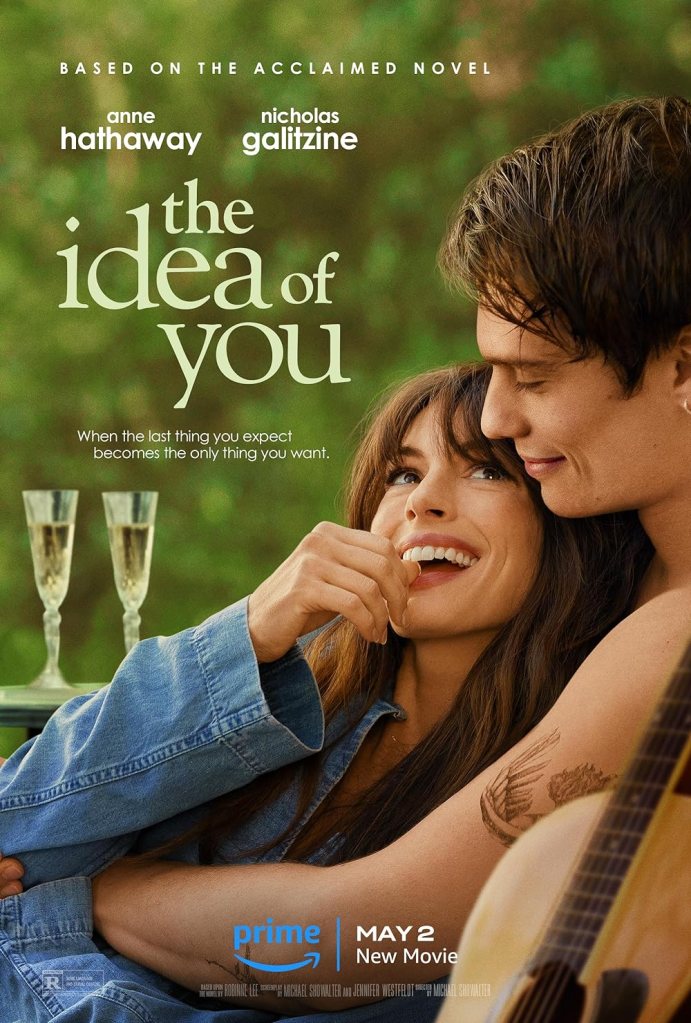

Director: Michael Showalter
Writers: Michael Showalter, Jennifer Westfeldt, based on the novel by Robinne Lee
Cast: Anne Hathaway, Nicholas Galitzine, Ella Rubin, Annie Mumolo, Reid Scott
Much of the time, authors and screenwriters write about their personal experiences with some dramatic license here and there. Sometimes, they write about their own fantasies because fantasy is often much more titillating than reality. Enter, Robinne Lee. Her novel, The Idea of You, became hugely popular, and as often happens with hugely popular novels, it was made into a movie. The story, however, seems to cater to a particularly niche market, and yet, perhaps it is not so niche as one might have originally thought due to its apparent popularity. Have co-writers Michael Showalter and Jennifer Westfeldt really given the world something interesting to indulge in, or should Lee’s novel have been left on the shelf?
40-year-old divorcée Soléne (Hathaway) lives alone with her 16-year-old daughter, Izzy (Rubin). When Soléne takes Izzy and her friends to a meet-and-greet VIP event at Coachella, Soléne meets 24-year-old singer Hayes (Galitzine). After their initial attraction and Hayes’s relentless pursuing of Soléne, they begin dating. At first it’s a whirlwind of glitz, glamour and lust, until the pressures of Hayes’s fame and their age gap begin to catch up with them and those around them.
To start with, I was intrigued by the older woman/younger man trope of this film (often it’s the reverse), and before knowing what the premise actually was, I assumed it would probably be something like a ten-year age gap. So, I embarked on a tedious journey to read the novel before the movie was released. The novel differs in that Soléne turns 40 during their time together, Hayes is actually 20 and Izzy is 12/13 and obsessed with Hayes’s boyband (in the film she is more indifferent having grown out of her boyband phase). This was already off-putting enough, but not too terrible. However (and not to turn this into a book review), I could not stand Soléne by the end, and the writing felt very ‘fanfic’, giving the distinct feeling that the author has/had a crush on real-life boybander Harry Styles (Hayes’s character is clearly modelled on Styles, the name ‘Hayes’ alone giving that away, nevermind the multiple other giveaways). The book overall did not go down well with me.
Now, about the film itself. Showalter and Westfeldt did away with much of the cringey moments and the clichés and toned down the lust and very teenage/young adult (on Soléne’s side) sexual language, making the story a little more believable and palatable. The changes made suited the story much better and gave the characters a little more depth and understanding. The novel came across more like an older woman’s fantasy of being a rich and sexy near-middle-ager who is craved by a much younger man, which felt kind of crass, but the film version of Soléne was much more down-to-earth and able to make proper decisions without being clouded by pure lust. The love was much more potent and believable between an older woman still very much in her prime and a younger man who has more maturity and a slightly more appropriate age. The ending in particular was much more of a triumph than the lacklustre “what was the point of all this” ending the novel proffered.
On reading the book, I had trouble picturing Hayes and Soléne. No matter how I pictured them, they never suited, and part of that was down to the way their characters were written. They just didn’t make sense. However, the film felt entirely different. Hathaway is a naturally stunning woman barely into her 40s who could absolutely get away with dating a man 16 years her junior. Her performance was not borne out of the potential for Hayes to have some severe mummy issues, but instead a mutual attraction and understanding between two people. The lust was still there, but Hathaway provides the mental connection and balances the fantasy and reality that the characters needed to become believable, something that book Soléne was sorely missing. Likewise, Galitzine’s performance was much sturdier than the novel counterpart. His version of Hayes is a little more mature and his language is more suited to his age (novel Hayes seems to swing between talking like a horny 16-year-old and a twice-divorced university professor), and, again, the lust is there, but the developing emotional connection is far more palpable. The choice to up his age was a good idea, as was the same idea for Izzy, played by Rubin. It made her character much more understanding of her mother’s relationship, even if it did still take a toll on the character, she was able to deal with it in a more mature way.
I didn’t expect to write a full review of this film, but considering the important differences between book and movie, I felt the need to do so. The Idea of You could very easily take a step away from being related to the book. Even a title change would make far more sense, considering the ending of the film in comparison to the book. It still has a handful of cringey moments, but it’s to be expected. It rather reminded me of Fifty Shades of Grey, in which I found the books to be fairly ‘meh’, but enjoyed the films a good bit more (at least the first two parts, the third was also rather ‘meh’). Fans of the book may not appreciate the film quite as much, but those like me who did not particularly enjoy the book may find that the film is easier to digest. The themes of age and fame are dealt with more aptly and feels less like a woman’s private sexual fantasy. Each to their own when it comes to personal enjoyment, but when putting these ideas out into the world, it helps to make it a little more tasteful, which thankfully, this film did.


 Dawn of the Tapes
Leave a comment