
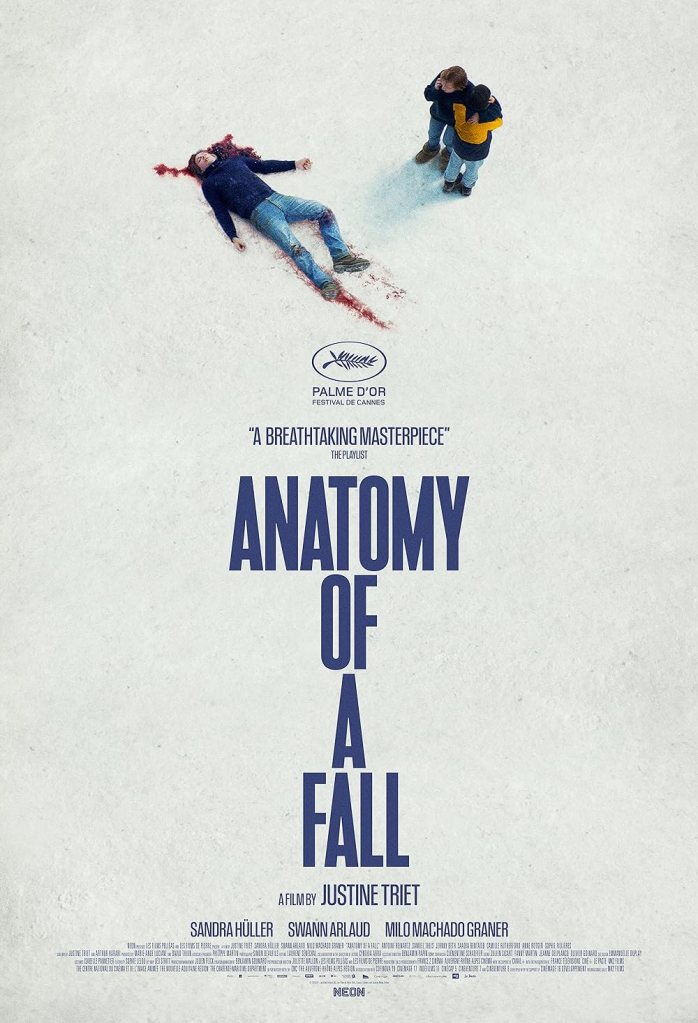

(Anatomie d’une chute)
Director: Justine Triet
Writer: Justine Triet, Arthur Harari
Cast: Sandra Hüller, Swann Arlaud, Milo Machado Graner, Antoine Reinartz, Samuel Theis, Jehnny Beth, Sophie Fillières, Anne Rotger
Do you ever find yourself wondering about the lives of other people? Sitting in a coffee shop, watching people pass by, or strolling down the street and noticing how people hold themselves differently. Facial expressions, body language, tone of voice. Do you ever notice differences in the people you believe you know extremely well? How well do we really know anyone, stranger or not? It seems that none of the above applies when people are on trial in a court of law, where any number of truths could come to the surface. In Justine Triet’s Anatomy of a Fall, not only do we see a ‘regular’ woman put on trial for the possible murder of her husband, but we are also privy to the ins and outs of their relationship, the good, the bad, and the very, very ugly, just the same as the judge and jury. Who, or what, exactly is Triet putting on the stand here, and is it worth invading someone’s privacy over?
In a chalet near Grenoble, France, German writer Sandra (Hüller) lives with her French husband Samuel (Theis) and their visually impaired son Daniel (Machado Graner). Sandra and Samuel communicate in fluent English rather than either’s native language. As Sandra is giving an interview, it is interrupted by Samuel’s loud music. After the interviewer leaves the house, an apparent accident occurs in which Samuel falls from a third-floor window and dies. Sandra is suspected of murder and put on trial, employing her friend Vincent (Arlaud) as her lawyer. Numerous people are called on to testify as to Samuel’s state of mind and character, Sandra’s relationship with him, and to reconstruct events and offer plausible causes of Samuel’s death. Daniel is also called upon to give his account, causing some tension between him and Sandra. Many details become known, particularly revolving around Samuel and Sandra’s relationship, some of which do not paint Sandra in a good light.
Anatomy of a Fall is marketed as a courtroom drama/legal thriller, which it certainly is, but it is so much more than your average ‘whodunnit’. From beginning to end, Triet guides us like a sturdy boat on the rough seas of a tumultuous marriage. Everything is presented to us chronologically without the use of flashbacks, other than under the guise of voice recordings given as evidence in Sandra’s trial, the goal of which is to make the audience feel as though we too are members of the jury receiving the evidence and testimonies through the trial. Triet also makes the most of each scene, ensuring that everything has some meaning. Sometimes directors can be so blatant with their use of music, mise-en-scène, cinematography etc. to push their insinuations and euphemisms to the point of being patronising. However, every part of Triet’s film has a sense of honesty and authentic purpose, such as Daniel’s visual impairment representing a kind of blind justice, and the constant switching between English and French, which is a struggle for Sandra at her trial, even more so with neither being her native language. Everything works together quite perfectly to portray an imperfect situation.
As we become more enlightened about Samuel and Sandra’s relationship, it really does come down to personal opinion as to whether Sandra had a hand in Samuel’s death. In many ways, it is not Samuel’s death that Sandra is on trial for: it is the demise of their relationship. It is uncomfortably put under the microscope by the prosecution, to the point of pulling up Sandra’s own writing techniques and inspirations for her books and drawing outlandish conclusions, doing so much more than blurring the line between fiction and reality, instead downright cutting it. It is an interesting framework for how relationships are always seen from two perspectives (at least), where neither is wrong and neither is right, two sides to every story, each perceiving their own point of view to be reality and the other’s fiction. The problem here is that one side is dead and unable to advocate for himself. It also says a lot about how women are perceived when it comes to difficulties within relationships. It would be interesting to see how the trial would be conducted had Sandra been the deceased and Samuel the accused.
Much has already been said about Hüller’s performance, including multiple awards and nominations (including Best Actress for the upcoming Academy Awards and BAFTAs). Indeed, her portrayal of Sandra is enticing, in the sense that we can find ourselves constantly searching her expressions, body language and words for any hints about Sandra’s innocence or guilt. The level of emotion is poignant in those moments where Hüller let’s Sandra’s emotions get the better of her. Machado Graner gives an almost expert performance as Daniel, exceptional for someone so young. He encapsulates Triet’s writing and puts forth a fantastic portrayal of a young boy caught in that moment where he learns his parents are far from perfect, and then having to put that aside to figure out the truth for himself. Reinartz’s Vincent is a great shoulder for Hüller’s Sandra to lean on and lends more legitimacy to her character through Vincent’s unending loyalty. Theis’s scenes are few yet are some of the most intense. His and Hüller’s energies bounce of each other fervently, providing some truly jarring scenes. All in all, this film has a great cast that deliver, including in the supporting roles (shout out to Messi, the border collie who played Snoop, Daniel’s guide dog. The real MVP).
Anatomy of a Fall is an interesting and insightful dissection of a relationship purely from an outsider perspective. It’s a perspective that, under normal circumstances, no one has a right to have, and yet, arguably, all relationships are constantly judged in different ways by people who have no understanding or knowledge of the people involved or any hardships they have endured. Deducing whether someone committed a murder is perhaps easier, as we can be presented with facts and evidence. How is it possible to determine facts in a relationship when each party has their own point of view? Who has the right to pass judgment on others’ relationships? Triet has done a wonderful job of looking uncomfortably close at the realities of intense relationships and how they’re perceived by others through the structure of a murder trial. It is really an astute piece of filmmaking that deserves its awards and current multiple nominations (including Best Film and Best Director).
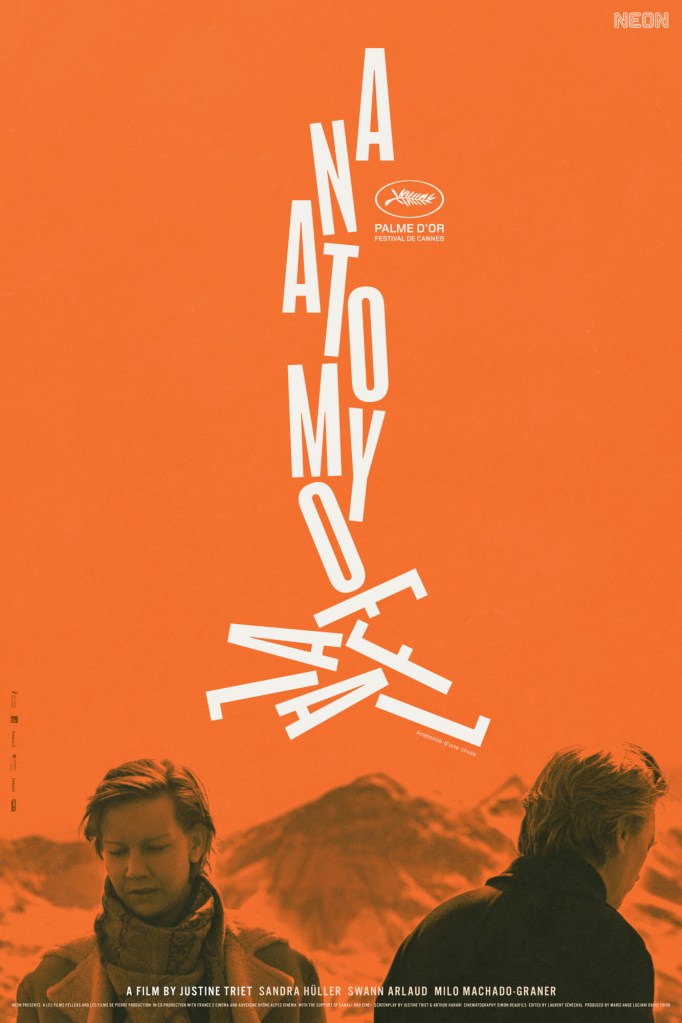
A final addition of a poster for this movie that I find particularly appealing (by Aleks Phoenix):



 Dawn of the Tapes
Leave a comment