
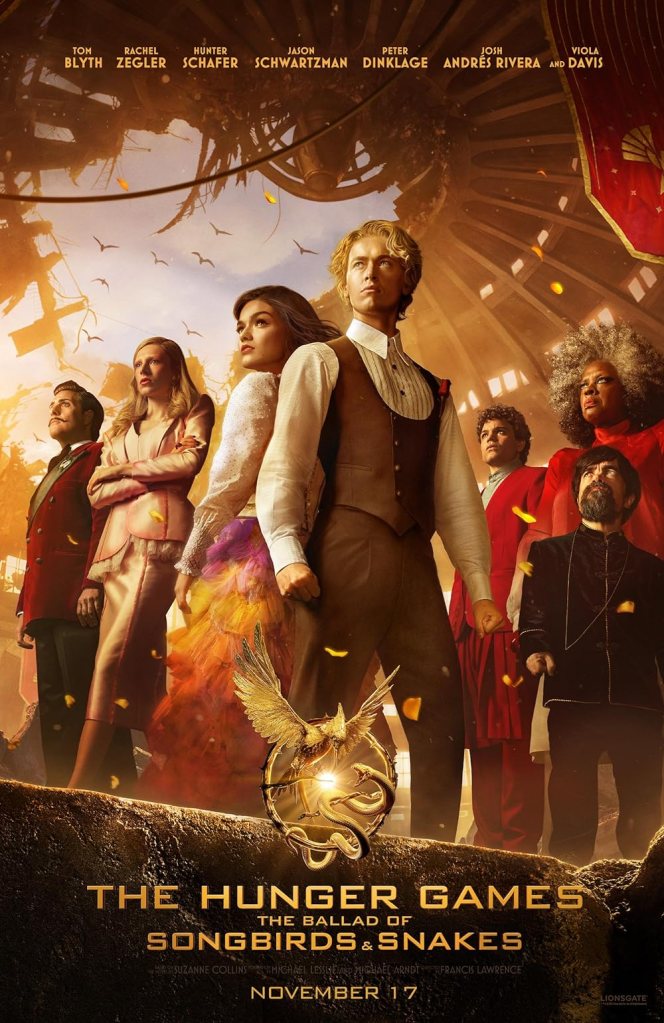

Director: Francis Lawrence
Writers: Michael Lesslie, Michael Arndt, based on the book by Suzanne Collins
Cast: Tom Blyth, Rachel Zegler, Viola Davis, Peter Dinklage, Hunter Schafer, Josh Andrés Rivera, Jason Schwartzman
2015 was the year we last had anything from The Hunger Games film franchise. Since then, author Suzanne Collins has released a prequel novel, which of course was almost immediately picked up to be given the big-screen treatment. The first four movies performed extremely well, garnering over three-billion dollars cumulatively worldwide: no pressure for The Hunger Games: The Ballad of Songbirds and Snakes, then. The Hunger Games books and movies were all released in that very special time of the late-2000s to the mid-2010s when the Young Adult readership was smashing records, partly thanks to the social media boom in which word-of-mouth was less “mouth” and more “keyboard”. The tweens were having fun with it, the teens were in love with it, and those of us in our late teens/early twenties at the time were fascinated by it (and thus, fanfic blew up and became more than just a nerdy pastime). It’s then little surprise that the fans wanted more, and Collins gave them just that, then director Francis Lawrence (who also directed the previous Hunger Games movies, bar the first) provided the on-screen version. Just like other franchises based on a YA book series, the success of The Ballad of Songbirds & Snakes likely balances on pleasing the old fandom and attracting a new audience. Does it satisfy the OG Hunger Games fans who want more while engaging said new audience, or was this one tribute too many?
Quick disclaimer: I have not read The Ballad of Songbirds & Snakes, but I have read the previous Hunger Games trilogy (though a very long time ago) and seen the film adaptations (a few times), so this review will be very much film-based.
SPOILER WARNING: Contains spoilers for the previous Hunger Games movies, but if you haven’t seen those by now, you may as well crawl back under your rock.
64 years before Katniss Everdeen enters the Hunger Games arena, 24 high-ranking Capitol Academy students are each assigned a tribute from one of the 12 Districts of Panem (with one boy and one girl being selected from each District) to mentor for the 10th Hunger Games, with the purpose being a prestigious prize granted to the mentor of the winner. Coriolanus Snow (Blyth) is assigned Lucy Gray Baird (Zegler), a young, colourful, musical girl from District 12. On understanding that the Academy’s dean, Casca Highbottom (Dinklage), very much dislikes Coriolanus, Highbottom purposely assigns him Lucy Gray due to her rebelliousness and apparent inability to win people over (sounds familiar). However, Coriolanus puts his full support behind Lucy Gray, going so far as to risk his own wealth and status to not only ensure her survival, but to gain her affection, too.
For me, the initial movies didn’t rank high on my rating system. I found Katniss Everdeen to be rather lacking as a character and didn’t really understand the need for her as a conduit for the story. However, the surrounding characters (who were much more interesting) and the way the story darkened as the series went on kept my attention. The way The Ballad of Songbirds & Snakes differs is that it held my attention without even trying. The writing is solid and the pacing doesn’t falter through the plot. It tells a great backstory to the Hunger Games and how certain characters evolved the way they did, including many that weren’t present in this movie but are descendants of some characters, and how Panem “evolved” the way it did. Unlike many prequels, this film doesn’t feel like a prequel for prequel’s sake: every event matters and every character matters. Everything (as far as I could see) linked in well to what we know to happen in the future of Panem, especially Coriolanus’s descent into anger and vengeance before eventually becoming President.
The production as a whole was much more toned down than that of the Hunger Games series. Whereas before we had huge open spaces serving as the arenas, in this prequel we see how the arenas started off much smaller, claustrophobic even, in comparison. It creates a tighter, tenser atmosphere, though the violence is just as startling. The costumes too are toned down, a pre-colourful Capitol colour palette being that much drabber and more uniform. It works to enforce more meaning around Lucy Gray, who is about the only light and colour for a significant chunk of the film, making it seem like colour isn’t the only thing the Capitol will steal from the Districts in the future. Similarly, the Districts (or at least District 12) haven’t yet become the dire places they are destined to be, with music and laughter still filling the air at times, even with the Peacekeepers, the Capitol’s law-enforcement, hanging around (no pun intended, considering how they execute “criminals”). There are a lot of things added into the sets and costume designs that can be linked to what happens in the future, but as mentioned before with the events and characters, nothing is there just for the fun of it: it all has meaning.
Something that pleasantly surprised me about this film was the performances and the characters. In particular, Blyth stands out as Coriolanus Snow, as he successfully portrays an inner conflict that is eventually won over by his darker side. A lot is revealed about Coriolanus that will make you want to watch the original Hunger Games movies again to really put two-and-two together for the younger Snow and his older counterpart. (I have heard that the Coriolanus in the book has much more conflict within his internal dialogue, something that wasn’t shown in the movie, so his struggle is not quite as obvious on-screen. It could have been a good narrative technique to use, but it could also have slowed down the pace of the movie – it’s quite a double-edged sword.) Likewise, Zegler’s Lucy Gray was an unexpected delight (I perhaps had some prejudice due to disliking Katniss). Zegler’s performance is electric, giving us a very unique character in Lucy Gray, and although her musical abilities were a surprise involvement at first, it became intrinsic to the character and helped to establish that difference between Capitol (i.e. Coriolanus) and District (i.e. Lucy Gray). Davis makes for a good villain with her role as head (and first) gamemaker Volumnia Gaul – twisted and mad as a scientist, her eyes say it all throughout. Schwartzman as Lucretius “Lucky” Flickerman, the first host of the Games, is a good pre-cursor to Stanley Tucci’s Caesar Flickerman, giving us much of what Tucci did but in a more “original” way. Dinklage brews a quiet storm as Dean Highbottom, Schafer gives a good performance and origin to Snow’s cousin Tigris, and Rivera represents the majority of us as Sejanus Plinth, an ex-District 2 resident whose family grew wealthy and moved to the Capitol, though he is morally against the Hunger Games, almost giving us a voice within the movie that wants to rebel along with him.
The Ballad of Songbirds & Snakes was not only entertaining and informative regarding the world of The Hunger Games, but it’s made me forgive some of the things I thought were too cheesy in the original series, or things I just didn’t enjoy. This was one series that not only needed a backstory but deserved one. Does it have the most original plot in the world? No, but rarely does any film. What many other films, particularly prequels, are often unable to do however is utilise a familiar plot in a way that actually makes sense for and correlates to the story that we know. Collins and Lawrence have done right by the fans in expanding the story in a way that is loyal to the core themes and characters, and many other writers and filmmakers could certainly do with taking a leaf out of their book and screenplay, respectively.




 Dawn of the Tapes
Leave a comment