
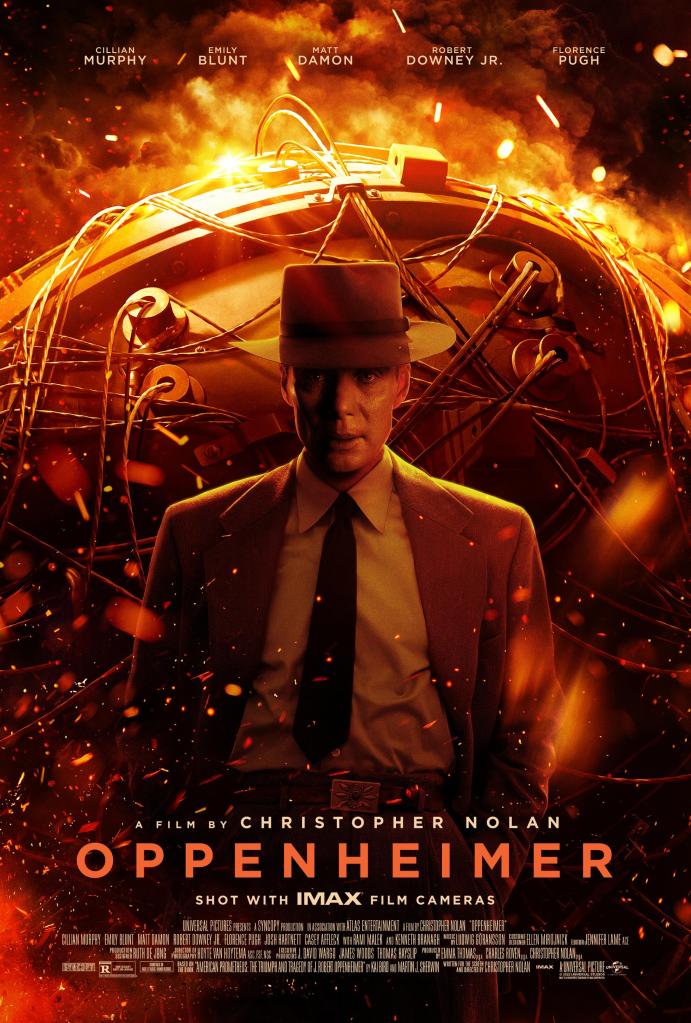

Director: Christopher Nolan
Writer: Christopher Nolan
Cast: Cillian Murphy, Robert Downey Jr., Matt Damon, Emily Blunt, Florence Pugh, Josh Hartnett, Casey Affleck, Rami Malek, Kenneth Branagh, Benny Safdie, Jason Clarke, Dylan Arnold, Tom Conti, James D’Arcy, David Dastmalchian, Dane DeHaan, Alden Ehrenreich, Tony Goldwyn, Jefferson Hall, David Krumholtz, Matthew Modine, Jack Quaid, Josh Peck, Christopher Denham, Alex Wolff, Gary Oldman
Movies based on true events of historical significance are generally notorious for the dramatisation of details that are often of little import and can incite potential controversy over interpretations of larger, more meaningful details. Movies, ultimately, are about entertainment, so of course liberties will always be taken, and poetic license oft used. The story of J. Robert Oppenheimer and the atomic bomb, whilst absolutely one that is significant in human history, is very heavy on the science, something many may consider less than entertaining, and would certainly need some drama behind it to really be a successful summer blockbuster. Does Christopher Nolan’s film, based on the Oppenheimer biography American Prometheus by Kai Bird and Martin J. Sherwin, offer us a genuine insight into one of the greatest scientific minds of the 20th century in a way that also respectfully puts a spotlight on one of the most important and tragic events in human history, or have we been given yet another account of a historical event shrouded in inaccuracies and warped for our “entertainment”?
In 1942, theoretical physicist J. Robert Oppenheimer (Murphy) is recruited by the U.S Army to create an atomic bomb to be used to put an end to World War II. In spite of his broad links to the Communist Party in the U.S, something the government considered a potential threat to national security should any of their nuclear secrets reach the ears of the Axis powers, Oppenheimer puts together a team of renowned scientists to develop the bomb in a hastily built laboratory town named Los Alamos in New Mexico. Following Germany’s surrender, discussions over the necessity for the bomb are quickly quashed when President Truman (Oldman) orders it to be dropped on Hiroshima and Nagasaki, Japan. Following these events and the celebrations that ensue, Oppenheimer begins to question the morals behind the use of nuclear weapons, himself beginning to have visions of people’s bodies and lives being torn asunder as a consequence of his atomic bomb. Thus, his loyalty to the United States is pulled into question and his entire life scrutinised, resulting in being cast out of scientific and political circles, regardless of what many consider to be his heroic contributions to protecting his country and effectively ending the war.
One of the first things to note is that Nolan achieves a very successful balance between the science-heavy jargon used and keeping up the pace and holding our attention during the denser scenes. They are interspersed with scenes of a more personal nature surrounding Oppenheimer’s relationships and his conscience in relation to his work, something that was necessary to give us a rounder view of who Oppenheimer was as well as keep the movie pushing forward. Not only does this benefit a broader audience with less than a physicist’s knowledge of much of the inner workings of nuclear science, but also leaves us suitably entertained yet educated; nothing is dumbed down, but much of the exposition and explanations of the science involved are done in the simplest way without being patronising. Similarly, the political atmosphere of the time and the way science and politics collide can be a lot for your average citizen (myself included), however Nolan has again threaded the two together well through the dialogue, particularly when it involves Lewis Strauss (Downey Jr.) and Oppenheimer, and Nolan’s decision to separate Strauss’s point of view from Oppenheimer’s through the use of black and white (“Fusion”) versus colourful (“Fission”) imagery.
The shifts between the facts and the speculative narratives in Oppenheimer are generally done well but not always entirely smoothly. As the plot progresses and Oppenheimer’s personal life comes more to the forefront, things do get a little jagged. Nolan’s decision to frame much of the main events as flashbacks during Oppenheimer’s hearing are fairly straightforward but not always the easiest to follow. Oppenheimer appeared to have rather a colourful personal life, and Nolan does not shy away from delving deep into the people, particularly the women, that influenced the scientist in more ways than one. It does give us a better idea of who Oppenheimer was as a person, however as this film isn’t a biopic in the traditional sense, some of the scenes felt unnecessary in the grand scheme of things and perhaps the overall flow of the movie could have fared better with less picking apart of his personal affairs.
Nolan’s cast is one to behold. It gets a little difficult to suspend your disbelief when there’s yet another famous face entering the scene every ten minutes, however for the most part the performances are fantastic and it’s not too long before you’re back in the movie again. It would be difficult to go through every performance, so we’ll just go with the standouts, the biggest of which is of course Murphy’s portrayal of Oppenheimer. Murphy’s performance is a true tour de force, his onscreen presence being everything you would want of a lead actor. He makes it appear effortless, embodying everything about the scientist, from his assertiveness and brilliance to his crisis of conscience and bare honesty. Blunt’s portrayal of Oppenheimer’s troubled yet loyal wife Kitty is also exemplary, with the chemistry between Blunt and Murphy working very well onscreen. Likewise, Pugh’s chemistry with Murphy as Oppenheimer’s complicated lover Jean is sizzling, but a pleasing and stark contrast to that of Blunt’s. These performances boost those of all the men we’re saturated with throughout the movie (to be expected considering the time and men’s roles in science and politics at the time). Downey Jr., never one to shy away from a hefty role, turns in a great performance as Strauss. Overall, the performances throughout are stellar, in spite of all the big names and well-known faces.
Oppenheimer is indeed a heavy film. In my opinion, it does lighten a lot of the science to draw a wider audience, but do not be fooled – there’s no handholding here. If you should find yourself zoning out at any point, you better pull yourself in, because this film does not slow down for anybody. Topping the 180-minute mark, officially Nolan’s longest movie to date, you best be prepared for a cerebral experience and a sore arse. Don’t be put off by the subject matter; it’s interesting, enlightening, thought-provoking and incredibly important. It’s a reminder of the power we have and the responsibility we have when considering wielding that power, not to mention the consequences. Oppenheimer, while certainly taking liberties here and there, proves itself worthy of telling the story of the atomic bomb and its “father” pointedly yet succinctly, and I’ll be watching the upcoming film awards season with great interest to see how Oppenheimer will fare.


 Dawn of the Tapes
Leave a comment