
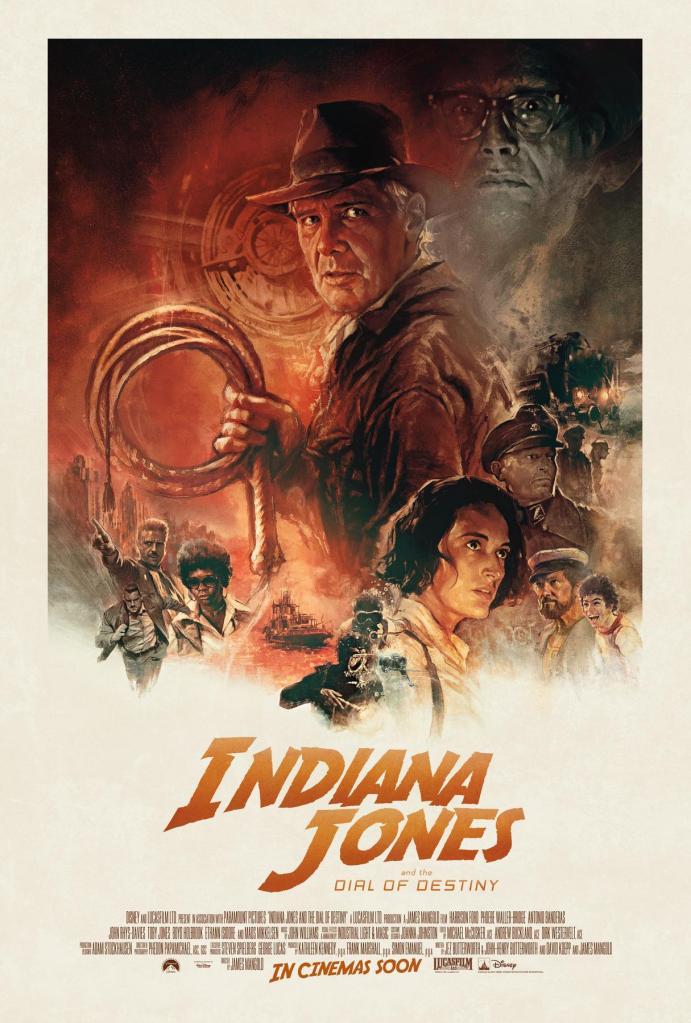

Director: James Mangold
Writers: Jez Butterworth, John-Henry Butterworth, David Koepp, James Mangold
Cast: Harrison Ford, Phoebe Waller-Bridge, Toby Jones, Mads Mikkelsen, Ethan Isidore, Thomas Kretschmann, Antonio Banderas, Boyd Holbrook, John Rhys-Davies, Shaunette Renée Wilson, Karen Allen
The name Indiana Jones is so ingrained in pop culture that it’s hard to imagine a world in which he doesn’t exist. The character is synonymous with many movie tropes: ancient booby-traps, escaping Nazis, discovering the existence of supernatural forces, and somehow glamourising archaeology, just to name a few. It’s little wonder fans would want to see the adventures of Indy for a fifth time, in spite of an aging Harrison Ford. Although 2008’s Indiana Jones and the Kingdom of the Crystal Skull divided critics and fans (while being the highest-grossing Indy movie up to that point), there was never any real doubt that a fifth movie would round out the franchise. Is it something that’s been worth waiting for, or should Indy have hung up his famous brown fedora and whip a long time ago?
In 1969, man has just set foot on the moon for the first time, and the world, particularly America, is celebrating. It’s a new era, and Indiana Jones (Ford) is close to retirement, feeling unimpressed at the world’s advancements and a little nostalgic for the old days of fighting Nazis for artifacts and saving the world, much like he did in 1944 with friend Basil (Jones) when they took half of Archimedes’ Dial from the Nazis. When Basil’s daughter and Indy’s estranged goddaughter, Helena (Waller-Bridge), drops into his life to request his help in finding the second half of the Dial, Indy is once again roped into another adventure (reluctantly, yet excitedly) to stop Nazis from going back in time and ensuring Germany wins the Second World War.
As you might tell from the above synopsis, the general plot isn’t exactly something new for an Indiana Jones movie, in that he is once again fighting Nazis for an ancient and near-mythical artifact that has some kind of supernatural or physically improbable ability that could change the course of history. But isn’t that kind of one of the reasons why we love the Indiana Jones movies? We can rely on them to give us a clear good vs. evil story where good (or at least moral good) triumphs over evil. The framework of the movie is familiar, and it had all the potential to be a boring repeat, but where I think this movie succeeds and manages to prevent too much repetition and boredom is that it keeps things understated. If you think back to/watch Raiders, Temple of Doom, The Last Crusade and Crystal Skull, there is usually a core three lead characters (Indy, a young male sidekick and a woman, or Sean Connery), and then there’s a legion of people chasing Indiana and his companions, with big vehicles and action sequences featuring a large ensemble of extras. Not so much in Dial of Destiny. We still have our core three in Indy, Helena and young Teddy (Isidore), but this time they are pursued by just a handful of bad guys (aside from the initial ’44 flashback, but that’s just to throw us back into the world of Indiana Jones initially and feed us some of that nostalgia that older Indy will be feeling). It makes the movie feel like it’s wrapping things up nicely, bringing Indiana’s story to a close like the last few easy seconds of a rollercoaster, rather than out with an unnecessary bang, because, let’s face it, Indy is too old for that now. The angle of Archimedes and his time-travelling Dial was a somewhat unique one to take, with Indy’s desire to relive the old days, so it worked to reflect our hero’s state of mind in his twilight years.
Although Dial of Destiny retains a lot of Jones charm and is enjoyable enough as a last hurrah for Indy, it does ultimately feel, to quote Bilbo Baggins, like butter scraped over too much bread. As much as Ford has always been up to a fifth instalment (and, I believe, Spielberg and Lucas being under contract since the seventies to create five Indy movies), the fourth and certainly fifth movies should have been completed in the 90s/00s. The gap in time between the movies was just too much to create two final movies that are fully worthy of the Jones name. Part of the charm of the original trilogy was the amount of cheesiness that a lot of 80s action movies exuded, not to mention the non-sensical storylines where plot holes abounded (looking at you, Raiders), but people were too busy enjoying the action and Harrison Ford being a handsome hero with humour to bother to read too much into it. This is not the case nowadays, where any Steve, George or James can make a movie, and thus the industry is far more competitive and films, particularly their screenplays, are scrutinised from the ground up. While I commend movies that allow for a greater range of age in its lead stars, watching Ford trying to keep up with younger co-stars felt a little unhinged. Of course, it wouldn’t do to have Indiana Jones take a backseat in one of his own movies and become purely some kind of archaeological consultant. That’s not what we expect of the character. But rather than let the man go gracefully into retirement, they had to squeeze him for the last bit of life left in him. It feels like a weird hypocritical thing to say: yes, we wanted more Indy, but perhaps not this way. Maybe Dial of Destiny will be better received by folk around the same age as Ford, who see this as a show of resilience and that old age doesn’t mean dead. Perhaps my opinion will change in forty years, if I’m lucky to live so long. I’ll get back to you on that.
Ford does a great job of reviving Indy, and he does his best to keep up with the pace of the film and clearly hasn’t lost the characterisation of arguably his most famous character. The AI used to portray a younger Indiana is remarkable, to the point where you can hardly notice that it’s not real. Truly the best age reversal I’ve seen in a movie (much better than the ones done in Star Wars). But, it is a little jarring to hear Ford’s aged voice on his younger face. Waller-Bridge brings some of her signature humour to Helena, which can feel a little fourth wall-breaking at times (as though she really wants to break it, à la Fleabag), but she also has wit, independance and smarts that many women in Indiana Jones movies have been missing in the past. Isidore’s Teddy felt like a token sidekick more than a necessity and could easily have not existed, though Isidore brought a good balance of depth and childishness to the character. Mikkelsen plays yet another villain and is your standard Indiana Jones nemesis (that being that he is German, a Nazi and ignorant as heck), and brings nothing particularly new to the table. Rhys-Jones, Banderas, and Allen have differing levels of cameos/roles, but none feels more important than the other, rather just a callback to older Indy movies and, in the case of Banderas, hiring a popular actor for a brief role perhaps just to add another known name to the roster. Holbrook’s role as Nazi sympathiser Klaber is much like Isidore’s Teddy: unnecessary and the plot would lose nothing without him. So, generally the characters written were either not crucial to the story in anyway, nothing new to the franchise, or an attempt to improve on what was past (namely the female lead).
Overall, Dial of Destiny is a perfectly fine end to the adventures of Indiana Jones. As I’ve told many who have asked, it’s not the best film, but neither is it the worst. It’s better than Kingdom of the Crystal Skull, but still only hobbles into fourth place (Temple of Doom in third, Raiders in second, Last Crusade in first place). It has enough action and twists and turns to keep audiences invested, but it does seem to come in fits and starts, like constantly revving a motorbike to get it to the end of the road. If anything, it’ll get you in the mood to rewatch the original trilogy, and those movies are most certainly worth going back in time for.





 Dawn of the Tapes
Leave a comment